
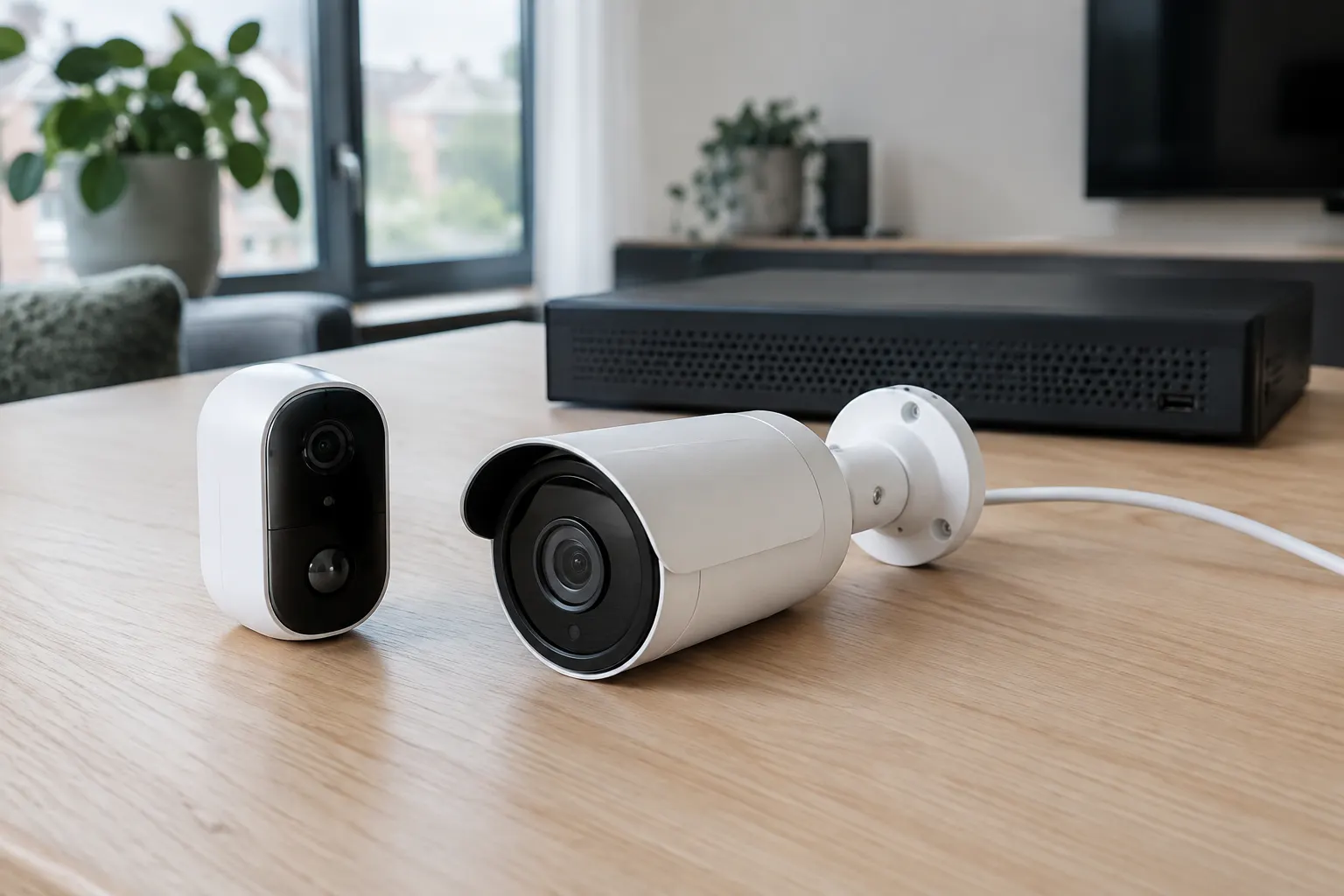
Ring, Arlo or Blink, or a fixed camera system after all?

When is Ring, Arlo or Blink a good choice?

We sell and install wired systems, so take that into account. But for a rented flat, a storage room, a caravan or a front door without any way to run a cable, we would not open up a wall either. A battery camera is up in half an hour and moves house with you.

They are strong in everyday things: seeing a parcel arrive, checking whether the children are home, talking back through the doorbell. The apps are simple. You do not have to choose a recorder or set up a network.

It changes when the camera has to provide evidence. Then you want to know what happened in the minute before the alert, even if the battery is empty or the Wi-Fi signal had just dropped.

What works without a subscription?

With Ring you can watch live and respond to alerts without a subscription. Playing back recordings requires a subscription, and so does setting the recording length. New devices come with a 30 day trial, so test again after that month what remains.

Blink gives motion alerts and live view without a subscription. With a Sync Module 2 and a USB stick of up to 256 GB you keep clips at home, for the cameras Blink lists. You need a subscription for cloud storage. Blink mentions different retention periods for Europe on its own pages, so check in the app what applies to your account.

Arlo allows local storage without a subscription, provided you have one of the listed hubs with a USB stick or microSD. Only automatically triggered recordings end up there; manual recordings and snapshots go to the cloud. Playback in the app only works with two newer hubs. With the others you take the storage out and view it on a computer.

What does a subscription cost over five years?

In November 2026 Ring charges 3.99 euros per month or 39.99 per year in the Netherlands for one device (Solo), 9.99 or 99.99 for all devices at one address (Multi) and 19.99 or 199.99 for Pro. Recording continuously 24 hours a day is an extra of 3 euros per camera per month, with 14 days of retention and only on suitable models.

An example with four cameras on Multi: five years is 500 euros. If you also want 24 hour recording on all four, another 144 euros per year is added and after five years you are at about 1,220 euros. That is without the cameras themselves, and prices can change along the way.

A fixed system has a higher amount at the start: recorder, drive, cables and installation. You replace a hard drive once. Put both in one sum before you choose, because cheap in the shop is not the same as cheap after five years.

What do you miss with a battery camera?

A battery camera sleeps. It wakes up when its sensor notices something and then records a clip. With Ring you set 15 to 120 seconds for battery devices, 20 by default, or up to 30 seconds as long as there is movement. Somebody who calmly walks along the edge of your view is sometimes only captured once they are already leaving.

The more happens, the sooner the battery is empty. Along a busy pavement the camera is therefore on the charger more often than in a quiet back yard. And do not turn the sensitivity down so far to save power that it no longer sees anything.

A camera with a cable does not have to choose. It can write continuously and only mark movement in the timeline. You then scroll back to five minutes before the incident.

What happens if the internet goes down?

A wired system simply keeps recording, as long as the recorder, switch and cameras have power. You just cannot watch while you are out. With an Arlo hub and local storage, recording also continues if your internet goes down, according to the manufacturer.

With a camera that only writes to the cloud, you should assume that nothing is added during that time. That is exactly the scenario people do not think of: an outage in the area, a router plug pulled out or a new Wi-Fi password that has not been entered in all cameras yet.

What are the drawbacks of a fixed system?

Cable has to go through the house, and that means drilling. The purchase costs more. Somebody has to run updates and check now and then whether recording is still working, because there is no service that quietly does it for you.

And everything is in one place. If somebody steals the recorder, the footage is gone, unless you also keep a copy elsewhere. So do not put it in plain sight next to the television but in a locked, ventilated space.

Is there a middle way?

Yes. Brands such as Eufy store locally where possible without a monthly fee for storage, for example on a HomeBase S380 that can be expanded to 16 TB with your own drive. There too, footage goes to the cloud if you switch on functions that need it.

You can also combine. A smart doorbell at the front for contact with visitors, and two wired cameras on the drive and at the back for recording. That is two apps, but each does what it is good at.

A simple rule: if you rent or it concerns one spot, start with a separate camera. If it is your own house, you want to cover more than two spots and you need to look back after a burglary, run cable.

AddedView →