
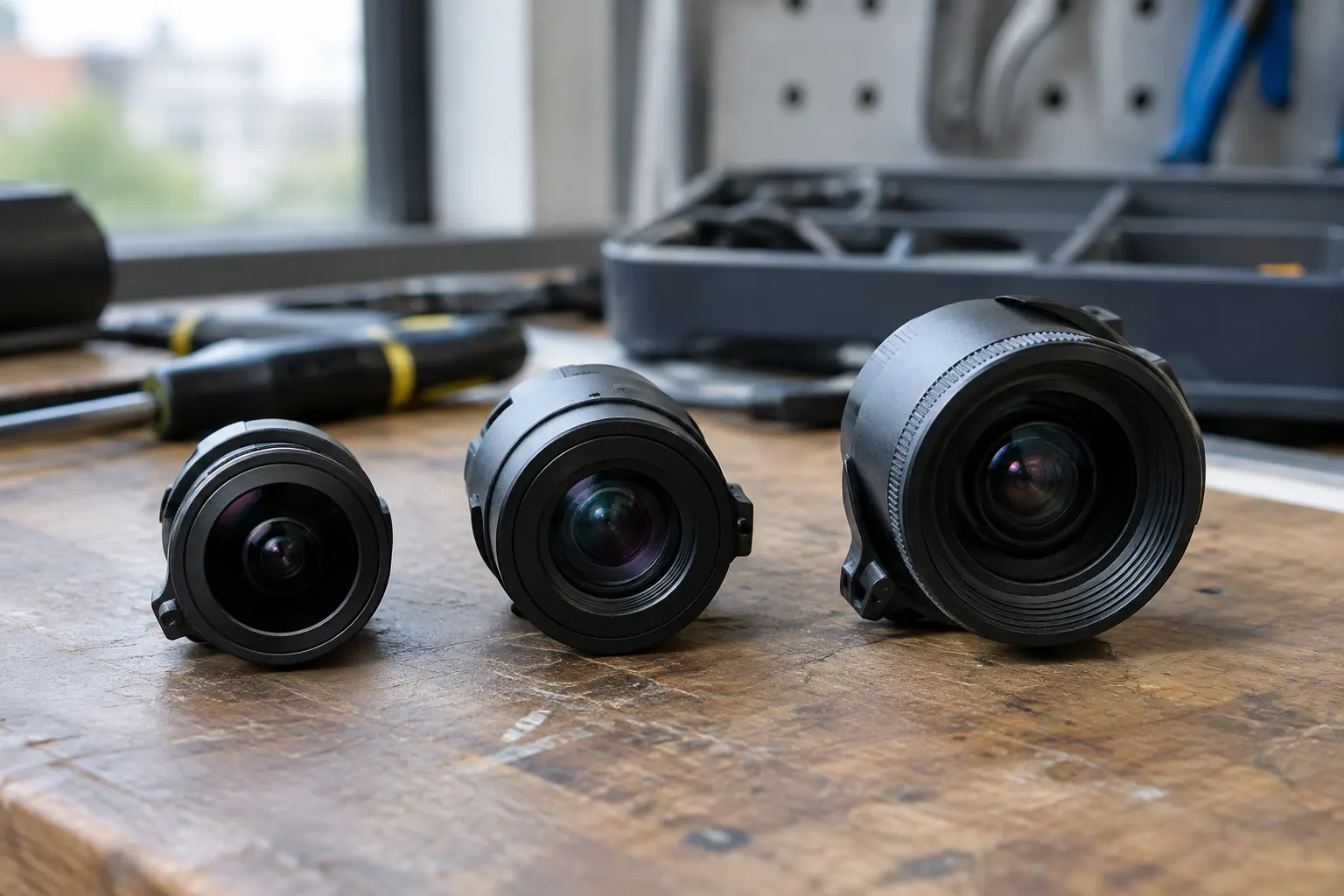
Which lens should you choose for your security camera: 2.8, 4 or 6 mm?
Advice - 25 November 2026 · 5 min read

Which lens should you choose for your security camera: 2.8, 4 or 6 mm?

Choose 2.8 mm if you want to see a lot close by, such as at a front door or in a small garden. Take 4 mm for a drive or wall where people walk at five to eight metres, and 6 mm for a gate or passage further away. The higher the number, the narrower the view and the larger a person appears. If you are not sure yet, varifocal is the safe choice.

Which lens should you choose for your security camera: 2.8, 4 or 6 mm?
In this article
  • What does 2.8, 4 or 6 mm mean on a camera?
  • How wide is the view at 5 and 10 metres?
  • Why is 4 mm not the same on every camera?
  • Which lens fits where around the house?
  • When do you choose a varifocal lens?
  • How do you test the viewing angle before you drill?
  • Which mistake is made most often?
At a glance

In short

At a distance of 10 metres, 104 degrees (2.8 mm) shows more than 25 metres and 51 degrees (6 mm) still shows 9.5 metres.
Millimetres cannot be compared between cameras: a 4 mm Hikvision lens sees 95 degrees, a 3.6 mm Dahua lens 84.
A motorised 2.7 to 13.5 mm lens goes from 104 to 29 degrees, so you can still adjust the viewing angle after mounting.

What does 2.8, 4 or 6 mm mean on a camera?

It is the focal length of the lens. A short focal length gives a wide view in which everything is small. A long one brings part of the surroundings forward and leaves out the rest. The camera records with the same number of pixels; you only spread them over a wider or narrower strip.

That makes the lens more important than people think. A 4 MP camera with 6 mm can show a face at ten metres that an 8 MP camera with 2.8 mm misses at the same spot.

How wide is the view at 5 and 10 metres?

Hikvision lists four lenses for one and the same 4 MP model: 2.8 mm with 104 degrees, 4 mm with 83, 6 mm with 51 and 8 mm with 39. That lets you work out the width: twice the distance times the tangent of half the angle.

At five metres that is about 12.8 metres wide with 2.8 mm, 8.8 with 4 mm, 4.8 with 6 mm and 3.5 with 8 mm. At ten metres it becomes 25.6, 17.7, 9.5 and 7.1 metres. This is calculated on a flat plane; wide-angle lenses bend the edges a little more.

With 2688 pixels across, the 6 mm lens then reaches about 280 pixels per metre at ten metres and the 2.8 mm lens about 105. According to the familiar DORI scale the first is enough to identify somebody, the second mainly to see what a person is doing.

Why is 4 mm not the same on every camera?

Because the sensor counts too. A larger sensor looks wider through the same lens. A 4 MP Hikvision with a large 1/1.8 inch sensor sees 95 degrees with 4 mm. A 4 MP Dahua with a smaller sensor sees only 84 degrees with 3.6 mm, although that smaller number should give a wider view. At ten metres the difference is almost four metres in width.

So compare the horizontal angle in degrees, not the millimetres. And do not go by the diagonal angle, because it is always larger and is sometimes the only one a web shop shows.

Which lens fits where around the house?

Front door under a canopy: 2.8 mm, so you also see the pavement and a parcel on the ground. Drive with the camera on the garage wall: 4 mm if the cars stand at five to eight metres. Back garden of a terraced house: 2.8 mm in the corner, because overview matters there and the distances are short.

An alley or side path is long and narrow. With 2.8 mm you waste most of your picture on two walls there. Choose 6 mm, or turn the camera a quarter if the model supports a portrait view. A gate or fence at twelve metres calls for 6 or 8 mm: for a 4 MP model Dahua lists an identification distance of 12.4 metres with 6 mm and 15 metres with 8 mm.

If you want both overview and faces at one spot, use two cameras. A wide one that shows everything and a narrow one aimed at the only passage. One compromise lens does half of each.

When do you choose a varifocal lens?

A varifocal lens can be adjusted. With a motorised version you do that from the app or recorder, without a ladder. A 4 MP Dahua model with 2.7 to 13.5 mm runs from 104 to 29 degrees, and the listed identification distance moves with it from 6.4 to 21 metres.

That is worth the money if the spot is high up, if the layout will still change or if you cannot judge the distance well. For the front door of a terraced house it is overkill. You know in advance what you will get there.

Do not confuse it with a PTZ camera. You set a varifocal lens and leave it. A PTZ turns and zooms during use, so there is always somewhere it is not looking.

How do you test the viewing angle before you drill?

The corner of an A4 sheet is exactly 90 degrees. Hold it level at the place where the camera will go and look along both edges. Fold that corner in half and you have 45 degrees, slightly narrower than a 6 mm lens.

Even better: hold the camera at the right height on a power bank or a long test cable and have somebody walk the route. Check on the phone whether the face is large enough at the point where it matters. Do that once in the dark as well.

Which mistake is made most often?

Using 2.8 mm everywhere because you see everything that way. You do see everything, except who it was. The second mistake is the opposite: a long lens right next to the door. A camera with a fast lens is not sharp at every short distance. For an F1.0 model Hikvision lists sharpness from 2.5 metres with 2.8 mm and from 3.1 metres with 4 mm.

And think of the neighbours and the pavement. A narrower angle records less public space, and that is usually exactly what you want.

Frequently asked questions

Can I replace the lens of my camera later?

With most fixed bullet, dome and turret cameras you cannot. The lens is focused on the sensor and the housing is sealed. You replace the camera or move it. Only box cameras usually have an interchangeable lens.

Is 2.8 mm or 4 mm better for a drive?

Measure the distance between the camera and the car. Within four metres, 2.8 mm is handy. If the car is further away or you want to see who is touching it, 4 mm gives larger faces and less street in view.

How many degrees does a camera with an 8 mm lens see?

About 40 degrees horizontally. Hikvision lists 39 degrees for a 4 MP model and Dahua lists 40. At ten metres that gives you a strip of just over seven metres.

Does a wide-angle lens make the picture rounder?

Yes, with 2.8 mm straight lines bend slightly at the edges and people look stretched or narrower there. So put the spot that matters in the middle of the picture and not in a corner.

Sources

What this information is based on

Hikvision 4 MP bullet datasheetViewing angles of the same model with 2.8, 4, 6 and 8 mm (DS-2CD2T46G1-4I/SL).View the viewing angles
Dahua IPC-HFW2441T-ASViewing angle and DORI distance with 3.6, 6 and 8 mm.Dahua product page
Dahua IPC-HFW2441T-ZASMotorised zoom from 2.7 to 13.5 mm with viewing angle and DORI distance.View the varifocal version
Hikvision 4 MP turret datasheet4 mm with 95.2 degrees and the focus range (DS-2CD2347G3-LI2UY).View the datasheet
Get help

Let us take a look

Send us your situation or call us directly. We help with cameras, alarms, the app and installation.

Request a quote
AddedView →