
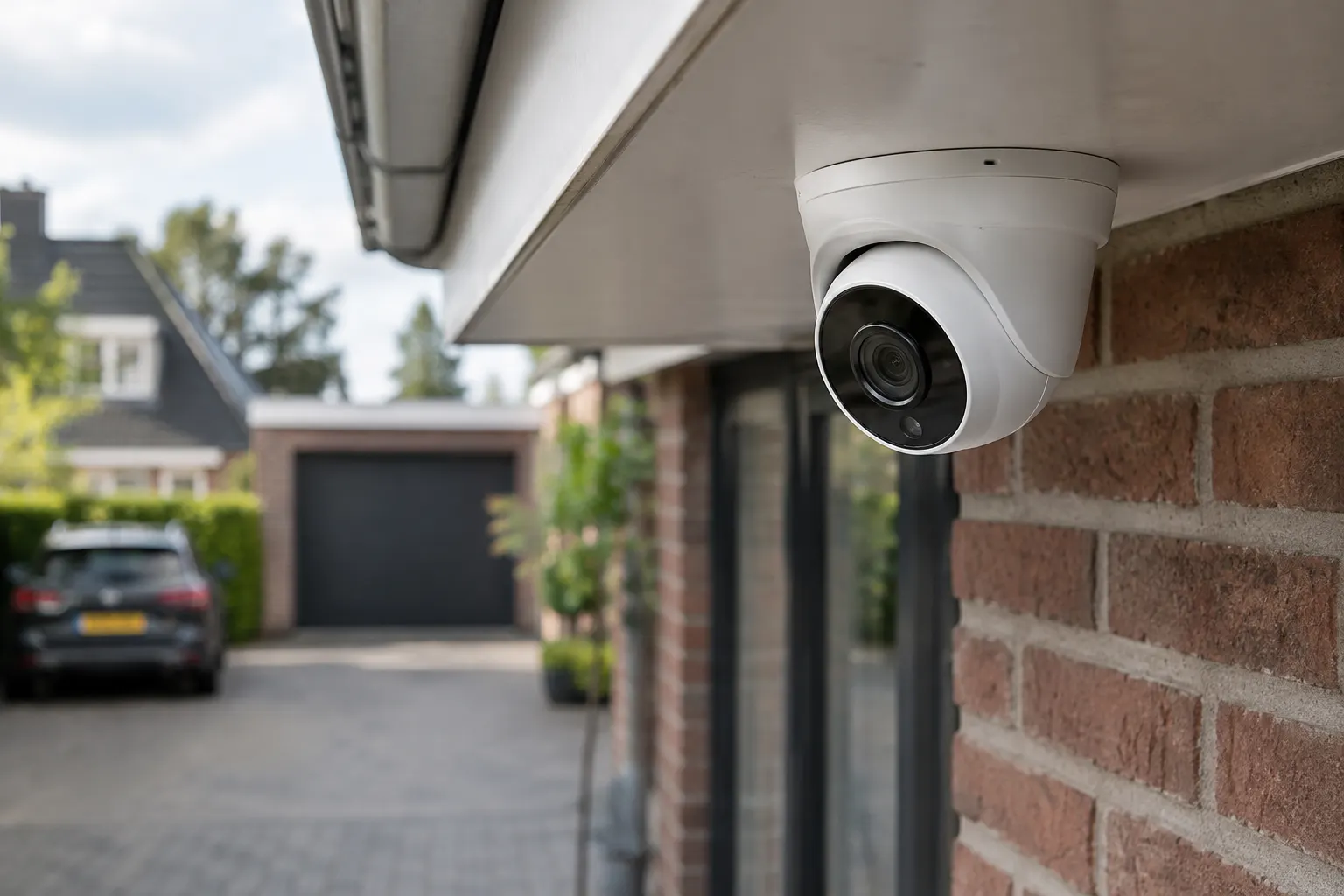
How many megapixels do you need for a security camera?
Guides - 25 November 2026 · 5 min read

How many megapixels do you need for a security camera?

For most spots around a home, 4 to 6 megapixels is enough. Only when a single camera has to cover a wide drive or a large site does 8 MP really add something. What matters is the number of pixels per metre at the spot where a person stands. To establish who somebody is, 250 pixels per metre is a widely used minimum.

How many megapixels do you need for a security camera?
In this article
  • How many pixels are 2, 4, 6 and 8 MP?
  • What are pixels per metre?
  • What do the DORI levels on the datasheet mean?
  • How far can you identify someone with 4 MP and 8 MP?
  • Does night vision get worse with more megapixels?
  • How much extra storage does a higher resolution need?
  • Which resolution should you choose for each spot?
At a glance

In short

Divide the horizontal resolution by the width of the view: 2688 pixels across 6 metres gives 448 pixels per metre.
With a target of 250 pixels per metre, 2 MP covers a strip of 7.7 metres and 8 MP a strip of 15.4 metres.
The standard was renewed in 2025: it uses 500 pixels per metre for verifying a known person or reading a number plate.

How many pixels are 2, 4, 6 and 8 MP?

Megapixels are width times height. A 2 MP camera usually records 1920 by 1080, a 4 MP camera 2688 by 1520, a 6 MP camera often 3200 by 1800 and an 8 MP camera 3840 by 2160. Brochures call that last one 4K.

Going from 2 to 8 MP sounds four times as sharp. Across the width you get exactly double; the rest is in the height. And the width is what counts when somebody walks through your view. From 4 to 8 MP you gain about 43 per cent across the width.

What are pixels per metre?

Picture a ribbon running straight across your view, exactly where a visitor stands. How many metres of ribbon fit in the picture? Divide the horizontal resolution by that number of metres and you have the pixels per metre.

An example: your camera hangs above the garage and, at the point where the car stands, six metres of drive are in view. With 2 MP that is 320 pixels per metre, with 4 MP 448, with 6 MP 533 and with 8 MP 640.

Point the same camera at a garden that is twenty metres wide and you get 96, 134, 160 and 192. Even 8 MP does not reach 250 there. You do not need a more expensive sensor then, but a narrower lens or a second camera.

What do the DORI levels on the datasheet mean?

DORI stands for detection, observation, recognition and identification. The levels come from the EN/IEC 62676-4 standard and are expressed in pixels per metre: 25 to see that somebody is there, about 63 to see clothing and behaviour, 125 to recognise a person you have seen before and 250 to establish who it is.

A new edition appeared in 2025. It uses seven different steps, from 20 pixels per metre for a general overview to 1500 for establishing an identity with high certainty. Verifying a known person or reading a number plate belongs to 500. Manufacturers often still print the old DORI distances, so ask which edition they use.

Treat the numbers as a calculation aid. Axis, which explains both versions, warns that backlight, compression, the lens and a turned head reduce the result. Conversely, a lower number can sometimes still give usable footage.

How far can you identify someone with 4 MP and 8 MP?

Two cameras from the same Hikvision series with a 2.8 mm lens make it concrete. According to the datasheet the 4 MP version reaches 6 metres for identification, the 8 MP version 8 metres. That is a two metre difference, not double the distance.

Also look at how such a distance is calculated. If you use a flat plane from edge to edge, you arrive closer to five and a half metres for that 8 MP camera. Wide-angle lenses distort towards the sides, and every manufacturer handles that differently. So plan with the shortest result, not the most flattering one.

Does night vision get worse with more megapixels?

It can. If more pixels are placed on a sensor of the same size, each pixel captures less light and the signal needs more amplification. Axis explains that this can give you a higher resolution with a poorer picture, especially in the dark.

You can see it in the same two Hikvision models. Both have a 1/1.8 inch sensor and an F1.0 lens, but the 4 MP version is rated for 0.0001 lux in colour and the 8 MP version for 0.0005 lux. Those are factory figures, so only compare them within one brand.

In a dark back garden without a lamp we would therefore rather choose 4 MP with a large sensor than 8 MP with a small one. If an outdoor light comes on, the higher resolution does get a chance.

How much extra storage does a higher resolution need?

More pixels need more data to keep the same detail. Of the two Hikvision cameras above, the 4 MP version goes up to 8 megabits per second and the 8 MP version up to 16. At the highest setting you write about 86 versus 173 GB per camera per day. In practice the bitrate is lower, but the ratio remains.

If you buy 8 MP and then turn the bitrate down to fit on the same drive, you throw away the detail you gained as soon as something moves. Include the drive in the calculation before you choose the camera.

Which resolution should you choose for each spot?

Front and back door: 4 MP is usually plenty, because the visitor stands close. A drive for one or two cars: 4 to 6 MP. A wide front garden, a car park or a warehouse with one camera: 8 MP, knowing that you are buying an overview. A shed or a corridor: 2 MP can be perfectly adequate there.

If you are torn between one 8 MP camera and two 4 MP cameras, the two are often the better choice. You get two viewing directions, fewer blind spots and still have footage if one fails. Keep a separate camera with a narrow lens for the spot where you need faces or number plates.

Frequently asked questions

Is 2 MP still enough for a security camera in 2026?

Yes, for a narrow spot such as a corridor, shed or side door. With a view of 7.7 metres wide, 1920 pixels gives you exactly 250 pixels per metre. If the view gets wider, you quickly lose recognisability.

Can I zoom in afterwards on an 8 MP recording?

You can enlarge the picture, but no detail is added. If a face was twenty pixels wide during recording, it stays twenty pixels. Digital zoom only helps if the pixels were already there.

Which resolution do I need to read number plates?

Use 500 pixels per metre, the level the 2025 standard gives for this. With 4 MP your strip is then 5.4 metres wide. Headlights and speed can still make a plate unreadable, so test in the dark.

Does the recorder matter with a higher resolution?

Yes. The recorder must handle the resolution per channel and the total of all cameras together. Check the maximum resolution and the total incoming bandwidth in the datasheet before you replace old cameras with 8 MP ones.

Sources

What this information is based on

Axis on IEC 62676-4:2025The seven new levels in pixels per metre and their limits.Read the Axis explanation (2025)
Axis on IEC 62676-4:2014The four DORI levels and the values behind them.Read the Axis explanation (2014)
Axis on sensor sizeWhy smaller pixels capture less light.Sensor size and image quality
Hikvision 8 MP datasheetResolution, DORI distances and light sensitivity of the DS-2CD2387G3-LI2UY.View the datasheet
Get help

Let us take a look

Send us your situation or call us directly. We help with cameras, alarms, the app and installation.

Request a quote
AddedView →