
Which UTP cable do you use for a security camera?
Guides - 25 November 2026 · 5 min read

Which UTP cable do you use for a security camera?

For a PoE camera, cat5e of solid copper is sufficient. If you are laying new cable, take cat6: it costs little more and you are set for later. Outdoors you need a black cable with a UV-resistant PE jacket, in the ground a filled burial cable. Leave cables marked CCA or copper clad aluminium alone and stay under 100 metres per run.

Which UTP cable do you use for a security camera?
In this article
  • Cat5e, cat6 or cat6a: what does a camera need?
  • Why not use CCA cable?
  • Which UTP cable is suitable for outdoors?
  • Do you need shielded cable?
  • How long can a camera cable be?
  • How do you fit a UTP connector according to T568B?
At a glance

In short

An 8 MP camera uses 16 megabits per second at most, while cat5e and cat6 can handle 1 gigabit.
The resistance of aluminium is about 55 per cent higher than that of copper: more heat and less voltage at the camera.
The 100 metres consists of 90 metres of fixed cable plus two patch cords of 5 metres.

Cat5e, cat6 or cat6a: what does a camera need?

Not much. The datasheet of an 8 MP Hikvision camera gives 16 megabits per second as the upper limit. Cat5e and cat6 are both meant for 1 gigabit per second. For the picture it makes no difference at all, not even with 4K.

Still, I choose cat6 for new work. The cable stays in the wall for fifteen or twenty years and the cameras in front of it do not. Cat6a is for 10 gigabits and with Draka almost eight millimetres thick, against five for cat5e. That is awkward in a full conduit and gains a camera nothing. Save it for a link between two switches.

If there is already a good cat5e cable of solid copper, leave it in place. Replacing it for a higher category is wasted money as long as it is undamaged and tests well.

Why not use CCA cable?

CCA stands for copper clad aluminium: aluminium wire with a thin layer of copper. It is light, cheap and the box may well say cat6. According to Fluke Networks it does not comply with the standards for network cable, because those require solid copper.

With PoE the power runs through the same conductors. The resistance is about 55 per cent higher than with copper of the same thickness, so more is lost as heat and less voltage arrives. A camera can then work during the day and drop out as soon as the infrared lamps come on. A fault like that costs more hours than the cable ever saved.

How to recognise it: scrape the conductor with a knife. Copper stays copper coloured, CCA turns silver grey. A 305 metre box that is remarkably light is suspicious too. Buy from a brand that states bare copper on the datasheet.

Which UTP cable is suitable for outdoors?

Indoor cable usually has a jacket of PVC or halogen-free material and is not made for sun and moisture. For outdoors you choose polyethylene, PE for short. Draka, for example, supplies a cat6 outdoor cable with a black, UV-stabilised PE jacket and a filling that stops water creeping along the conductors.

There are roughly three situations. Exposed along the wall or in trunking: PE with UV protection. In a conduit underground: filled cable, because moisture gets into such a conduit sooner or later. Directly in the ground: only a cable for which the manufacturer states this, with mechanical protection against a spade.

Do not automatically use the outdoor cable indoors as well. In the Draka overview the PE cables have no CPR fire class, while the indoor cables carry Eca or higher. So change over to an indoor cable just behind the wall, for instance in a wall outlet or patch panel, and ask which class applies in a business property or apartment building.

Do you need shielded cable?

Not in an ordinary home. UTP without foil is more flexible and easier to terminate. Shielding such as F/UTP or S/FTP becomes interesting if the camera cable runs for a long way next to heavy current, frequency drives or lift motors.

Half a shield is false security. The foil has to continue to the plug, the box and the earth, otherwise you have a stiffer cable without any benefit. Simply keep data cables and 230 volts apart: own conduit, own route, and cross at right angles if there is no other way.

How long can a camera cable be?

The usual limit is 100 metres between switch and camera: 90 metres of fixed installation cable and 5 metres of patch cord at both ends. That is a design limit and not a wall. Cables exist that go further for slow devices, but then outside the standard and only as stated by the manufacturer.

Measure the route and not the distance. A camera 25 metres away as the crow flies easily takes 45 metres of cable through loft, cavity and crawl space. Leave half a metre spare at the camera and two metres at the recorder, so you can fit a plug again.

How do you fit a UTP connector according to T568B?

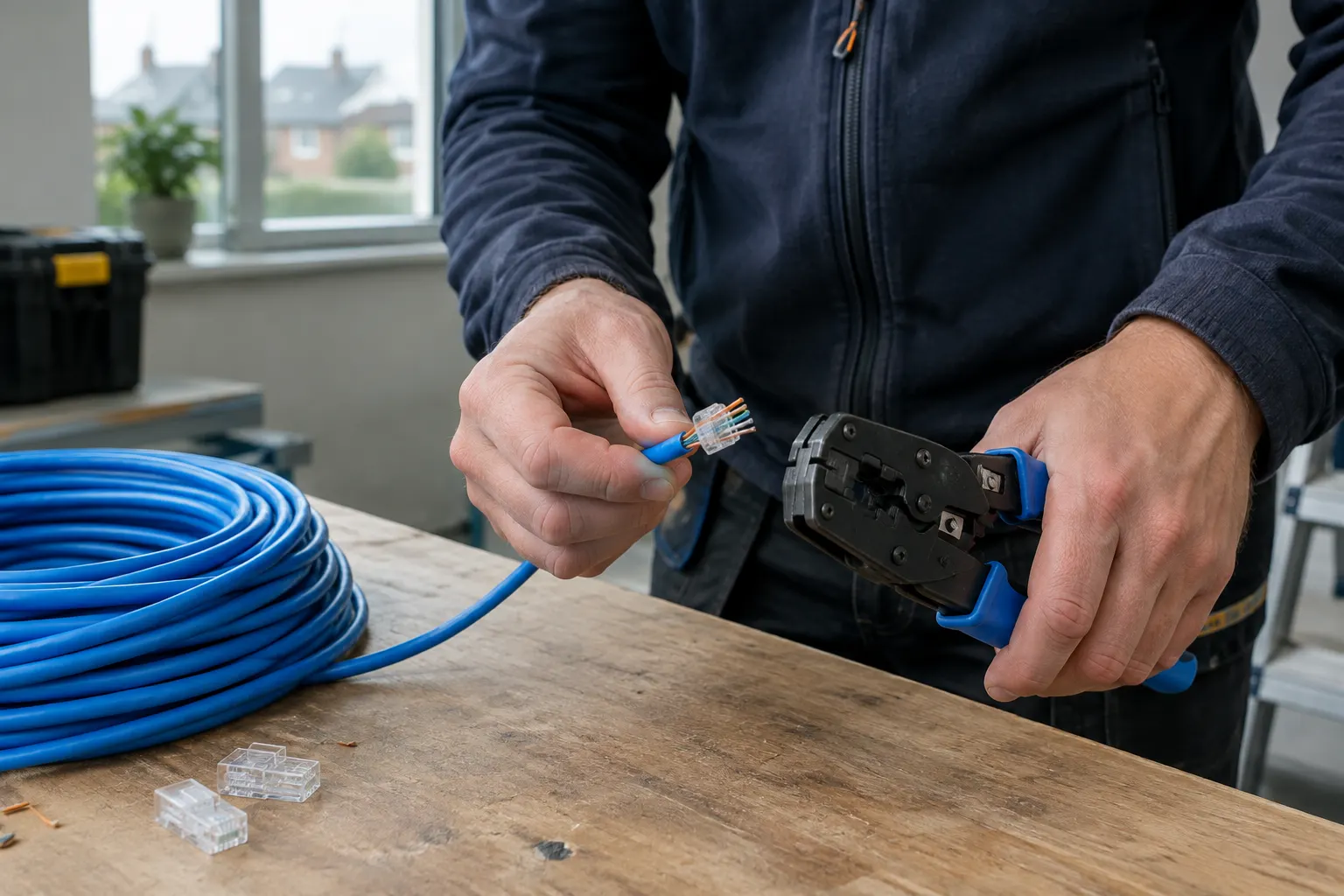
With the clip facing away from you and the contacts at the top, from left to right: white orange, orange, white green, blue, white blue, green, white brown, brown. T568A swaps orange and green. Both work equally well, as long as you do the same at both ends.

Do not strip too much. The pairs are twisted for a reason and should be loose for no more than 12 millimetres from the contact. Push the jacket into the plug as well so that the strain relief clamps the jacket. And watch the type: there are plugs for solid conductors and for stranded ones, and not every plug fits the thicker conductors of cat6.

The neatest way is to terminate a fixed cable on a keystone or wall outlet and do the last part with a ready-made patch cord. Then test all eight conductors with a tester. A camera that shows a picture can still have a bad pair.

Frequently asked questions

Can I use an existing telephone or coax cable for an IP camera?

Coax is possible with a pair of converters at both ends, if no new cable can be pulled. Old telephone cable has too few conductors or they are not properly twisted, so it is no reliable basis for PoE.

Is a flat network cable suitable for a camera?

For a temporary test it is, for a fixed installation better not. Flat cables often have thin conductors, sometimes come as CCA and are not meant to hang along a wall for years.

Can I extend a UTP cable with a coupler?

Indoors and within reach you can, if the total length is right. Outdoors every coupler is a place where moisture gets in. It is better to pull one unbroken cable from recorder to camera there.

How many cameras can share one UTP cable?

Normally one per cable. If you want two, you place a small PoE switch on the camera side that is itself powered through the cable. Do add up the power of both cameras.

What colour jacket should an outdoor cable have?

Colour alone proves nothing, although outdoor cable is usually black because carbon in the jacket helps against UV. Look for PE and UV-stabilised on the datasheet, and do not use a black indoor cable.

Sources

What this information is based on

Fluke Networks on CCAResistance, PoE and how to recognise CCA.Read the explanation of CCA
Draka data cable selection chart 2025Category, diameter, jacket, shielding and CPR class.View the selection chart
Draka SuperCat 6 outdoor cablePE jacket with UV stabilisation and water-blocking filling.Outdoor cable datasheet
FOA: terminating network cableT568A and T568B, plug types and how far to untwist pairs.Read the FOA guide
Get help

Let us take a look

Send us your situation or call us directly. We help with cameras, alarms, the app and installation.

Request a quote
AddedView →