
Ajax smoke detectors: which FireProtect 2 do you choose?
Alarms - 25 November 2026 · 6 min read

Ajax smoke detectors: which FireProtect 2 do you choose?

Ajax smoke detectors are called FireProtect 2. RB has batteries you replace, SB a built-in battery for 10 years and AC a mains connection. For an ordinary existing home in the Netherlands, a battery detector with EN 14604 is enough. The smoke versions we checked carry that standard according to Ajax.

Ajax smoke detectors: which FireProtect 2 do you choose?
In this article
  • What is required in a Dutch home?
  • RB, SB or AC: what do those letters mean?
  • Smoke, heat or CO: which sensor goes where?
  • Does an Ajax smoke detector comply with the law?
  • How do interlinked detectors work through the hub?
  • Where do you fit them?
  • What do they cost and is one brand handy?
At a glance

In short

Since 1 July 2022 a smoke detector is required on every Dutch storey with a living space or escape route.
FireProtect 2 SB has a battery for 10 years; with RB you replace batteries after 5 to 7 years.
After 10 years the whole detector has to go, with RB and AC too.

What is required in a Dutch home?

The rule is in article 3.117 of the Dutch Buildings Decree. An existing home has a smoke detector on every storey with a living space, such as a living room, bedroom or kitchen. A storey with only a hall through which you escape counts as well. The detector must comply with EN 14604. A loft that is only storage needs none.

The owner is responsible. If you rent, the landlord fits them, although your contract may leave testing and replacing batteries to you.

One detector per storey is the minimum, no target. With three bedrooms and closed doors you may not hear a detector in the hall. That is where interlinking makes sense.

RB, SB or AC: what do those letters mean?

RB stands for replaceable batteries. The FireProtect 2 RB holds two CR123A cells which, according to the specifications, last up to 7 years. The English manual states 5 years for the smoke and heat version, so count on the lower figure. The app warns you when they run low.

SB has lithium cells that are sealed in. Ajax gives 10 years for those, exactly as long as the sensor. After that you replace the detector as a whole. Handy above a stairwell.

AC connects to 110 to 240 volts and has a fixed lithium cell as backup. Such a detector needs a cable on the ceiling. Logical with a new build or renovation. Have mains power connected by a professional.

Smoke, heat or CO: which sensor goes where?

The usual combination is smoke and heat. The smoke sensor uses two kinds of light to judge particle size, so that steam gives no alarm according to Ajax. The heat sensor triggers above 64 degrees or when it gets 10 degrees or more warmer within a minute.

Carbon monoxide is a different danger. The CO version warns within 3 minutes above 300 ppm and within 40 minutes at 100 ppm. The Dutch fire service only advises a combined smoke and CO detector in rooms with a combustion appliance, such as near the boiler. Elsewhere a CO detector hangs at breathing height, while smoke rises to the ceiling.

In a garage or a room with exhaust gas or cooking fumes, Ajax points to a version without a smoke sensor. Note that a heat detector without a smoke sensor has a different standard. It does not replace the required smoke detector.

Does an Ajax smoke detector comply with the law?

For most existing homes it is about EN 14604. That standard is on the specification pages of the FireProtect 2 RB and SB with smoke, heat and CO, the RB with smoke and heat and the AC with smoke and heat. The CO versions also list EN 50291-1.

There are exceptions. With room letting, Dutch law requires smoke detectors under NEN 2555, and those must be mains-powered. New builds also come under NEN 2555, with requirements for power, backup, interlinking and location. Ajax does not mention that Dutch standard on the pages we viewed. So have it assessed before you buy for room letting, a new build or a change of use.

The manual of the AC version has one more footnote that is often missed. To comply with EN 14604 the fallback interconnection in the hub must be on. This is general information; the municipality supervises.

How do interlinked detectors work through the hub?

When one triggers, it sends an alarm to the hub and the hub activates the other detectors within 20 seconds. If the connection to the hub is lost, the detector does it itself: all linked detectors beep within a minute. That fallback needs firmware 5.59.2 or newer, and the box then says Fallback interconnect supported.

The detectors are always on, separate from your burglar alarm. In the app you read which detector it was. So you also know where you should not walk.

The built-in siren reaches 85 dB at 3 metres. That is loud, but closed doors muffle a lot. The fire service aims for 75 dB everywhere in the house. Walk a round with the bedroom doors shut after fitting.

Where do you fit them?

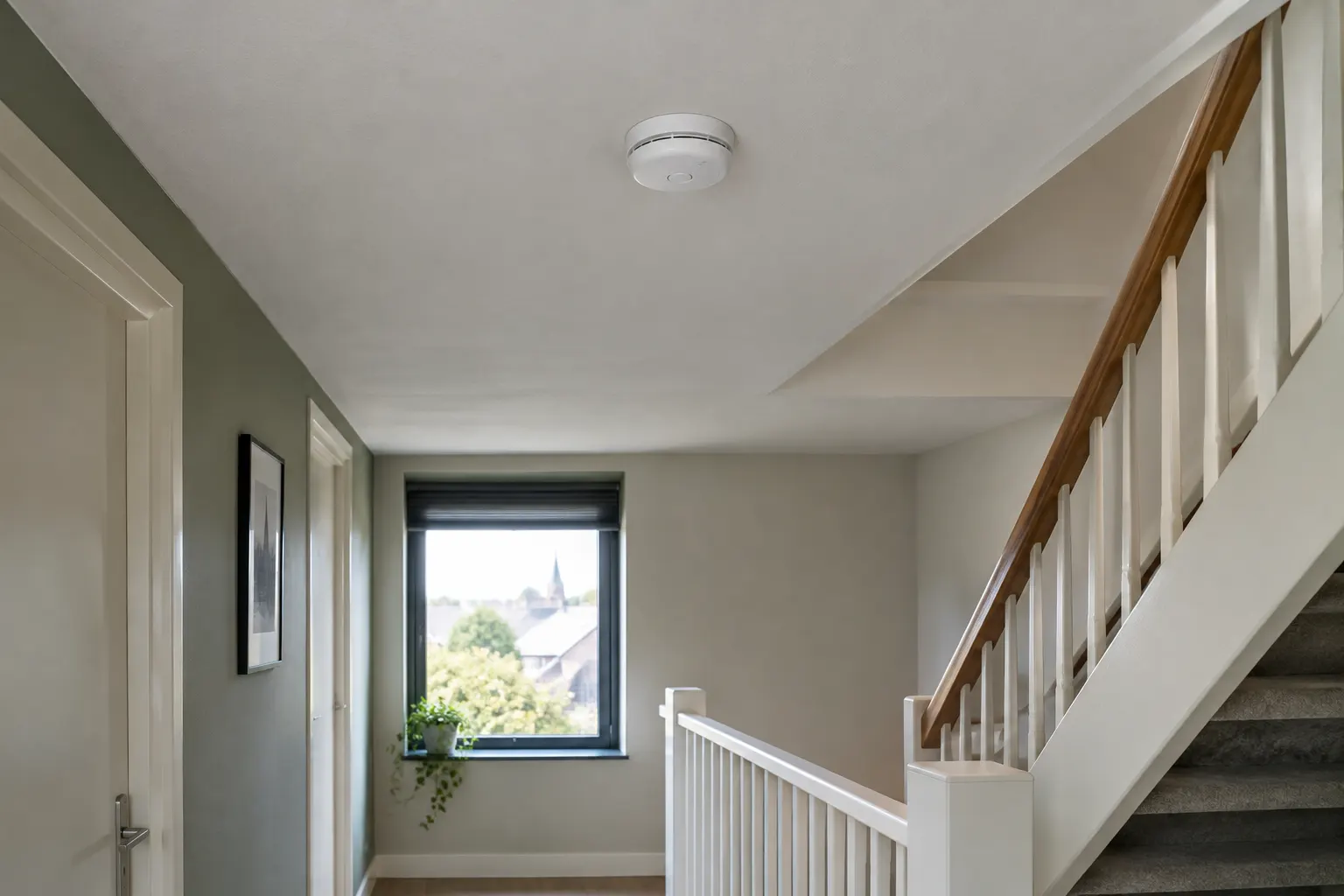
The middle of the ceiling in the hall and on the landing is the start, because that is your way out. Keep 50 centimetres from walls and corners and 30 centimetres from lamps. For sloping ceilings Ajax mentions about 60 centimetres from the ridge, measured along a perpendicular. The fire service uses 90 centimetres. In such a case follow the manual of the detector.

Do not fit one near a ventilation grille, above a radiator, in the bathroom or in a corner. Smoke arrives too late there or steam too early. On the wall is only allowed if the ceiling is impossible, for example because of closely spaced beams.

Measure the signal strength in the app before drilling. Ajax recommends two or three bars. Moving it 20 centimetres often helps.

What do they cost and is one brand handy?

In November 2026 a FireProtect 2 RB with smoke and heat starts around € 132 in our shop. The SB is around € 151. With CO it is around € 176 for the RB and € 221 for the SB. The AC versions are around € 165 without and € 216 with CO.

That is far more than a separate detector of a few tens of euros. It pays if you have an Ajax hub anyway and want an alert while away. If you have no alarm, interlinked detectors with EN 14604 from the shop are a fine choice. Mixing is possible, but then they do not talk to each other.

Frequently asked questions

Does a FireProtect 2 work without a hub?

According to Ajax the smoke and heat version can work without a hub: it then raises the alarm itself with its siren. You only get no alert on your phone and no linking through the app.

How do I test an Ajax smoke detector?

Hold the button on the detector or start the self-test in the app. The detector beeps and flashes when it works. The fire service advises doing this monthly, even though the system itself keeps track of faults.

Do I have to clean the smoke chamber?

Ajax writes that the smoke chamber of the FireProtect 2 is protected against dust and insects and needs no cleaning. Do keep the outside free of dust, and do not fit it in a very dusty room.

Does the monitoring station warn the fire service?

That depends on your contract. A smoke alert from a home does not go to the fire service by itself. In case of fire always call 112 yourself and go outside first.

Does a meter cupboard or storage room need a smoke detector?

Legally a storage loft or cellar without living space does not count, as long as no escape route runs through it. If you charge e-bike batteries there, the fire service does advise one.

Sources

What this information is based on

Dutch Buildings Decree (Bbl)Article 3.117 on smoke detectors in existing buildings.Go to wetten.overheid.nl
IPLO fact sheet on smoke detectors, November 2026 (Dutch)Existing buildings, new builds, mains or batteries.Go to the fact sheet (pdf)
Dutch fire service: smoke detectorsPlacement, interlinking, CO and replacement.Go to brandweer.nl
Ajax FireProtect 2 RB with smoke, heat and COStandards, battery, linking and thresholds.Go to the Ajax specifications
Get help

Let us take a look

Send us your situation or call us directly. We help with cameras, alarms, the app and installation.

Request a quote
AddedView →