
Preventing theft on a building site: what helps, and in which order?
Business - 25 November 2026 · 5 min read

Preventing theft on a building site: what helps, and in which order?

You prevent theft on a building site in layers. First leave less of value lying around: deliver on the day of use and store tools in a locked container. Then put up fencing, lighting and access by name. Mark equipment and only then place a camera with someone who follows up. Check the CAR (contractors’ all risks) terms beforehand, because they set requirements for storage.

Preventing theft on a building site: what helps, and in which order?
In this article
  • What is stolen most often, and when?
  • Layers 1 and 2: how do you remove the target?
  • Layers 3 and 4: what do fence and light really do?
  • Layer 5: do marking and trackers make sense?
  • Layers 6 and 7: when do you place a camera, and who follows up?
  • Layer 8: who pays if something does go missing?
  • What do you do in the first week of a project?
At a glance

In short

In the 2025 BauWatch report Dutch builders name small and power tools (53 per cent) and copper (49 per cent) as most often stolen.
Interpolis advises keeping no more aluminium on site than you process in a single day.
In the NN terms we read, there is no cover for theft-prone material from storage without signs of forced entry.

What is stolen most often, and when?

The figures that exist come mainly from parties that sell security, so read them with that in mind. The BauWatch survey of 400 Dutch construction professionals from 2025 names tools, copper, cables and fuel as the most popular loot. Of those surveyed, 69 per cent see more crime in winter, because of longer nights and quiet weeks around the holidays.

Striking for the approach: in the same report 21 per cent of incidents were theft with inside knowledge, by people with access or knowledge of the place. A higher fence does not help there. Planning, key management and a list of who was inside do.

Layers 1 and 2: how do you remove the target?

The cheapest thing you do is leave nothing standing. Agree with suppliers that copper, copper pipes, heat pumps, inverters and sanitary ware only arrive if they are fitted at once. For sites with aluminium Interpolis advises never to have more present than you process in one day, and to place fittings only just before use.

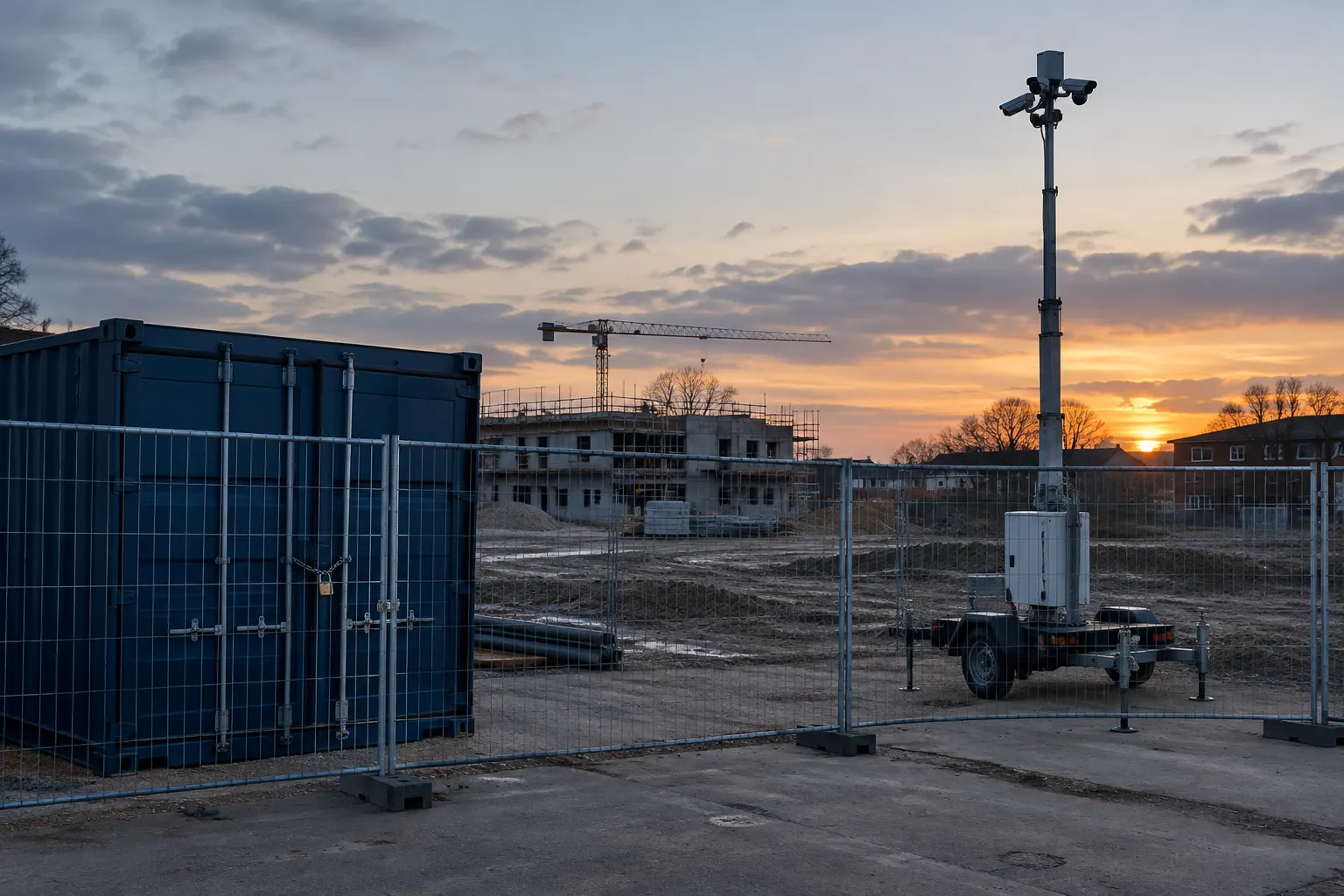
If something has to stay overnight, lock it up. Use a steel container with an approved lock and place it with the doors close against a wall or another container so they cannot be opened. Block the lifting point too, otherwise the whole container is taken. Tool boxes chained to a beam are a second hurdle, not a replacement.

Set down who may take what. A tick list at the end of the day costs five minutes and shows at once if something is missing.

Layers 3 and 4: what do fence and light really do?

A site fence is above all a boundary: whoever climbs over it walks somewhere they should not be. That makes follow-up easier. It only works without gaps. Check the couplings, do not place pallets or containers as a step against the fence and make one entrance you can close. A combination lock whose code everyone knows is no longer a lock.

Light helps if there is someone looking: a neighbour, a passer-by or a camera. Interpolis advises site lamps, also at night. Aim them inwards and downwards so that neighbours are not bothered, and put the plug out of reach. A lamp someone can pull out is no protection.

Layer 5: do marking and trackers make sense?

Marking with a name, postcode or drawing makes tools harder to sell on and lets the police return them. Engrave the casing, not only the battery. Write serial numbers in a list that does not lie on the site.

A GPS tracker or tag helps with large machines and trailers. Bear in mind that a tracker needs battery and reception, and may send nothing inside a steel container. Agree beforehand what you do with a signal: chasing a thief yourself is no plan, calling the police with a location is.

Layers 6 and 7: when do you place a camera, and who follows up?

A camera is useful if two things are arranged: it sees a place where someone can steal something, and there is someone who reads the alert straight away. Without follow-up you only have a clip of your copper leaving. So choose first who reacts in the evening and at the weekend, and only then the camera.

Let the camera report only people and vehicles. With flapping sheeting in view you otherwise get so many alerts that someone switches it off. Do not hang it where it will be hidden behind scaffolding next week. And take account of the people working there: filming is only possible with a clear purpose, as little footage as possible and a sign that says so.

Layer 8: who pays if something does go missing?

Article 7:758 of the Dutch Civil Code says that after handover the work is at the client’s risk. Until then the contractor usually bears the risk, but the contract and general terms can divide that differently. Write down whose material it is that has been delivered but not yet used, and who bears the excess. Interpolis advises clients to place that with the contractors, so that everyone has an interest in prevention.

A CAR policy often covers theft of building material, but not without conditions. In the closed-project CAR terms from Nationale-Nederlanden we looked at, boilers, sanitary ware, copper and other theft-prone material must be in a locked building or a steel container with an SKG-rated lock, and there must be signs of forced entry. If you fail that, the cover lapses. Tools and machines often fall under a separate section for auxiliary equipment.

Every policy is different. Read yours before the first container arrives and send photos of the storage to your adviser. This is general information and not insurance advice.

What do you do in the first week of a project?

Draw a map with three zones: where valuable stuff stands, where people come in and where you want to see nobody. Agree a loading moment per supplier, close the fence, place one key cabinet with a list and test the lamps on a dark evening. Put up a sign with the number neighbours can call.

Then walk the place once a week with the question: what would I take from here at eleven at night? Do that again at every change, because a site in week three is a different one from that in week twelve.

Frequently asked questions

Does a dummy camera help on a building site?

At most against someone who pays no attention. An experienced thief recognises it quickly and it yields no footage for a police report. One well-placed real camera makes more sense.

Must I always report a theft?

Do so: insurers usually ask for it, and without serial numbers the police cannot link recovered goods to you. Export camera footage straight away.

Who is responsible for building material that has just been delivered?

That depends on the agreements on delivery and ownership. Have the contract state from which moment the risk passes, and who stores it safely.

Can I film the site if passers-by walk past?

Aim the camera at your own ground and keep the public road out of the picture as much as possible. Put up a sign and set down who sees footage and how long you keep it.

Does it make sense to ask my neighbours to keep an eye out?

Yes, provided you give them a phone number and tell them when work is going on. Neighbours recognise a strange van on a Saturday evening sooner than a camera at a distance.

Sources

What this information is based on

BauWatch crime report 2025Survey of 400 Dutch builders, published by a security company.BauWatch report (pdf, Dutch)
Interpolis: theft during constructionAdvice on delivery, storage and lighting.Interpolis prevention tips
NN closed-project CAR termsRequirements for storage and signs of forced entry.NN terms (Dutch)
Article 7:758 Dutch Civil CodeWhen the work is at the client’s risk.Article 7:758 (Dutch)
Get help

Let us take a look

Send us your situation or call us directly. We help with cameras, alarms, the app and installation.

Request a quote
AddedView →