
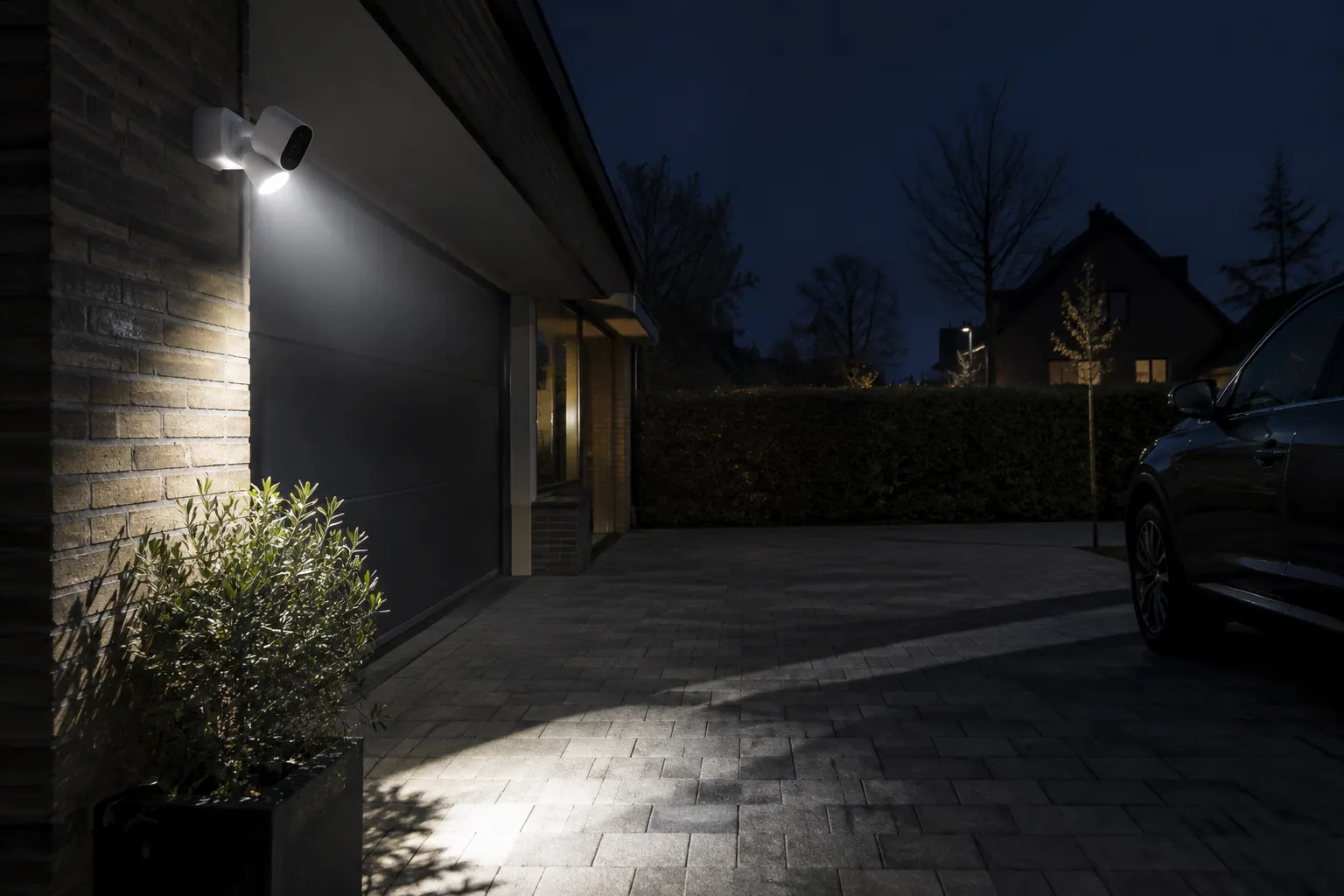
Camera with siren and lamp: does it really deter a burglar?
Guides - 25 November 2026 · 6 min read

Camera with siren and lamp: does it really deter a burglar?

A camera with siren and lamp reacts to a person itself: it flashes, shines white light or plays a warning. That deters mainly someone who wants to search at leisure, and does little against anyone who has prepared. It works well if the camera only reports people, is active only at night and the sound is no louder than needed. Switch it on silently first, and only with sound after a week.

Camera with siren and lamp: does it really deter a burglar?
In this article
  • What exactly does active deterrence do?
  • Dahua TiOC, Hikvision and Ajax: what is the difference?
  • How loud is such a siren in the street?
  • When does it make sense, and when not?
  • What do you do against false alerts?
  • What may you do to the neighbours?
  • How do you set it up step by step?
At a glance

In short

One Hikvision model states 95 dB at 10 centimetres, which is only about 55 dB at 10 metres in open space.
With Ajax the alarm system’s sirens go off on a camera, provided the hub has OS Malevich 2.31 or later.
Noise can be an unlawful nuisance under article 5:37 of the Dutch Civil Code, so avoid repeated false alarms.

What exactly does active deterrence do?

There are three separate signals. A lamp with white light that comes on when someone is recognised, a flashing light and a loudspeaker with a siren or spoken text. Some cameras have all of them, others only a lamp. So read carefully what is on the box, because the word deterrence says nothing about the number of decibels.

The trigger is as important as the signal. A camera that reacts to every movement raises the alarm over cats and bin bags. One that filters for people and vehicles makes fewer mistakes, but still makes some.

Dahua TiOC, Hikvision and Ajax: what is the difference?

In its TiOC cameras Dahua combines colour footage, active deterrence and recognition. The signal consists of red and blue flashing light plus a loudspeaker. The 2020 leaflet mentions up to 110 dB, spoken texts and a button in the app to switch it all off at once. For the IPC-HFW3549T1-AS-PV Dahua mentions eleven built-in sounds and the option to load your own voice.

Hikvision makes ColorVu models with a flashing light and a sound alarm. The datasheet of the 8 megapixel DS-2CD2387G2-LSU/SL names a 1.5 watt loudspeaker. In the recorder you set that reaction for the event you choose, with its own schedule.

Ajax takes a different route. The TurretCam HL switches on white light on motion, and you can let the camera activate the sirens already in your alarm system. That can be only when the system is armed or at any time, and camera and hub must be online at that moment. The hub needs OS Malevich 2.31 or later.

How loud is such a siren in the street?

The figures cannot be compared until you know the distance. Hikvision states 95 dB at 10 centimetres. Every doubling of the distance takes about 6 dB off in open space. At 1 metre that is just over 75 dB, at 10 metres about 55 dB. You hear that well on a quiet night, but along a busy road by day it is lost. A leaflet with 110 dB and no distance therefore says little.

The surroundings make it different. An alley with two walls reflects the sound and an open field swallows it. So do not decide on paper but listen yourself: one person at the camera, one at the boundary. Start low and only go up if it cannot be understood at the camera.

When does it make sense, and when not?

It works on a driveway, back path or business premises where nobody has any reason to be. Someone who hesitates is startled by light that suddenly shines on them, and a voice makes them think they are being watched. The footage gets better too: with light you have colour and less motion blur.

It works badly against someone who has prepared, in a busy spot by day and in an alley where every passer-by triggers an alarm. We know of no independent research that shows how many burglaries a camera with a siren prevents. See it as an extra layer and not as a replacement for a good lock or alarm.

What do you do against false alerts?

Draw the zone up to your own boundary, not up to the pavement. Set the minimum and maximum size of a person if possible, and let the camera run silently for a week: only an alert, no light or sound. Every alert in that week would otherwise have been an alarm. If more than a few are unjustified, adjust the zone first.

Set a schedule. By day only record and alert, in the evening light as well, and sound only in the hours when nobody at all should be there. Make sure everyone in the house can quickly switch it off when they come home.

Keep animals, delivery people, refuse collectors and your own cleaner in mind. Anyone who has to be on the premises regularly should know the schedule.

What may you do to the neighbours?

The Dutch Civil Code says you may not cause others unlawful nuisance, for example through noise. Whether that is so depends on the situation. Startling someone once a year is something else from three times a week at four in the morning.

Keep it practical. Aim the white light downwards and not at a bedroom window, use short signals and do not set the siren to repeat. Tell the neighbours you have a camera and how they can call you. Your municipality may have its own noise rules in local by-laws. This is general information and not legal advice.

Do not forget privacy. Even with a siren you remain responsible for what the camera films. And do not let a warning sound for someone who is simply walking along the pavement.

How do you set it up step by step?

Start with the picture: does the camera hang well, do you see in the dark what you want to see. Then set detection and limit it to people. Switch on alerts for a week, without light and sound. Only then switch on the light, and sound last, at a low level.

Test in the dark. Walk through the zone yourself, let a second person listen and write down the settings: times, volume, duration, who may switch it off. Set that down at handover.

Frequently asked questions

Is a siren on a camera the same as an alarm system?

No. A camera gives a warning and footage. An alarm system measures opening, movement and tampering and can react to alerts by a plan. Together they complement each other.

Can I use a message I recorded myself?

Dahua and Hikvision offer custom sound or voice on some models. Check it for the exact model, because the option differs per series and firmware.

Does the sound also go off if the internet fails?

A camera that makes sound itself can usually do so without internet. With Ajax, camera and hub must be online at that moment, so there it is a condition.

Do I have to put up a sign if the camera also flashes?

Yes, you let people who come onto your premises know that you are filming. Light or sound changes nothing about that, and a flashing lamp does not replace the sign.

Does the lamp also work in mist and rain?

Mist and rain reflect white light back into the lens. Dahua states that red and blue light stays noticeable in mist and rain. Make a test recording on a wet evening.

Sources

What this information is based on

Dahua TiOC leafletLight, sound and recognition according to the maker.Dahua TiOC (pdf)
Hikvision DS-2CD2387G2-LSU/SL datasheetLoudspeaker and sound pressure at 10 centimetres.Hikvision datasheet (pdf)
Ajax TurretCam HLLight and sirens that react to the camera.TurretCam HL manual (Dutch)
Article 5:37 Dutch Civil CodeNuisance between neighbours.Article 5:37 (Dutch)
Get help

Let us take a look

Send us your situation or call us directly. We help with cameras, alarms, the app and installation.

Request a quote
AddedView →