
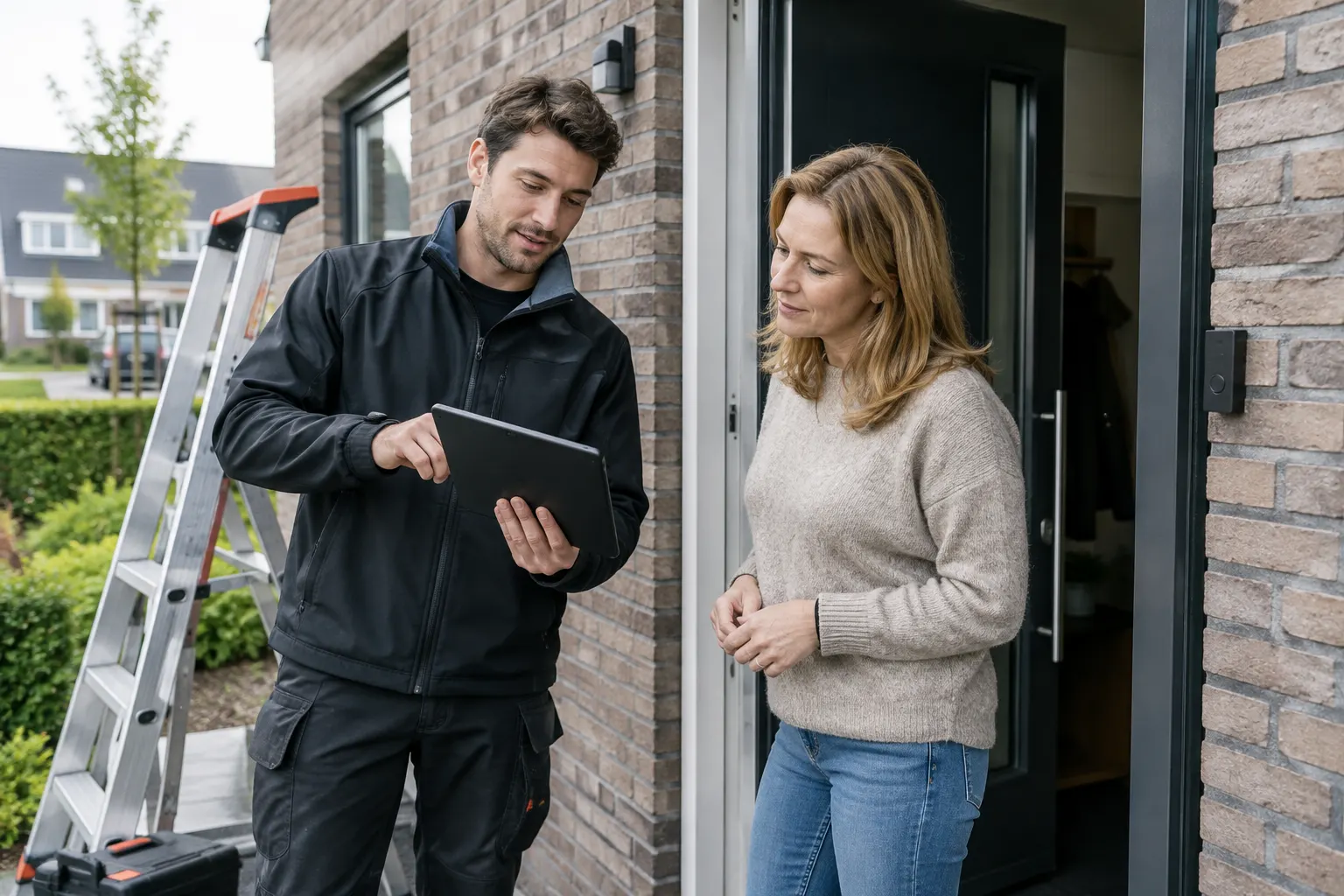
Choosing a camera installer: which questions do you ask beforehand?
Advice - 25 November 2026 · 6 min read

Choosing a camera installer: which questions do you ask beforehand?

A good camera installer first asks what you want to see, sets out the system in a detailed quote, gives you the administrator passwords and finds a recording together with you at handover. For cameras without a monitoring centre we found no diploma requirement in Dutch law. For alarms and cameras linked to one there is.

Choosing a camera installer: which questions do you ask beforehand?
In this article
  • Does a camera installer need a licence?
  • What do quality marks such as BORG and PKVW say?
  • Which questions do you ask before the quote?
  • Who gets the passwords and the footage?
  • How should a handover go?
  • Which installers are well rated?
  • When can you install cameras yourself?
At a glance

In short

BORG is not required by law, but an insurer can make it a condition.
For alarm equipment linked to a private alarm centre, engineers must have a recognised diploma and a declaration of reliability.
You remain responsible for where your camera points, even if a company mounts it.

Does a camera installer need a licence?

The Dutch act on private security organisations and detective agencies, Wpbr for short, governs licences for security companies, alarm centres and video surveillance centres among others. The agency Justis issues them. A company that only fixes a camera to your wall and stores the footage on your recorder is not in that list.

It changes when a monitoring centre watches. The alarm centre may then only work with engineers who hold a Dutch diploma such as Monteur Beveiligingssystemen or Technicus Beveiligingsinstallaties, plus a declaration of reliability. For cameras on a video surveillance centre there are separate CCTV diplomas. The duty in law lies with the centre, but you notice it: without such an installer the connection is not possible.

So first ask yourself whether you will ever want a monitoring centre. If so, say that before the quote and ask for the papers of the engineers who come. We are an installer ourselves, so read this article with that in mind and check what we say against the sources below. It is general information, not legal advice.

What do quality marks such as BORG and PKVW say?

BORG is about burglary protection. There are separate certificates: A for a security plan, B for structural measures such as locks, E for alarm installations. So a B certificate says nothing about your alarm. The Dutch crime prevention centre CCV writes that BORG is not required by law, but that insurers often ask for it.

The Police Label Secure Housing (PKVW) is about homes and mainly about locks and hardware. A PKVW company is therefore often a locksmith and not necessarily someone who can set up a network. For camera systems there are separate certification schemes. If you need one because of your policy, ask for the certificate number.

Always check a quality mark with the organisation itself and not by the logo on a van. The CCV keeps an overview of certified companies, which also shows if a company has been suspended. No quality mark is no proof of poor work, but nobody else has then checked it for you.

Which questions do you ask before the quote?

Start with the purpose. Ask: what will I be able to see at this spot, by day and at three in the morning? An installer who names a number of cameras at once without asking about walking routes, light and cable paths is selling a box.

Then ask exactly what is in the price: type and number of each part, storage in days, cabling, mounting at height, configuration, explanation and travel. And ask what is not included. A new circuit in the fuse box, a hole through a concrete wall or a wifi problem will otherwise turn up as extra work.

Finally the question that is rarely asked: what do I pay every month? Cloud storage, SIM card, app or maintenance can make a cheap system more expensive over three years than a dearer one. Also ask what keeps working if you cancel.

Who gets the passwords and the footage?

You do. The administrator account of the recorder and cameras is in your name and on your email address. The installer gets a separate user if he needs to help remotely, and you can switch that off. If a company refuses, you are tied to that company as soon as something breaks.

Ask whether default passwords have been replaced, whether every user has their own login and where the footage is stored. If you film customers or staff, also ask who at the company can watch. If a supplier can access personal data on your behalf, a data processing agreement usually belongs with it.

The Dutch Data Protection Authority advises watching along during configuration. Later you cannot hide behind the installer if your camera films the neighbours’ garden.

How should a handover go?

Set aside half an hour and do it on your own phone. View every camera live, have someone walk past the door and then find that movement yourself. Export one clip. If that does not work at handover, it will not work after a burglary either.

Ask for a page of paper or a pdf with: which camera is where, which cable runs where, model numbers, the retention period set, users and who you call in case of a fault. A future engineer will benefit a lot from it.

Do not sign off before the night image has been viewed. If that is not possible because it is light, agree that you can still respond after the first evening about reflections or a lamp in view.

Which installers are well rated?

We do not make a list, because we are a party ourselves. We can say how to read reviews. Skip last week’s five stars and look for messages from more than a year after installation. There you read whether someone answers the phone when a camera fails.

Look at how a company responds to criticism. Also ask for an address or photo of comparable work and a contact you may call. Or ring two companies with the same technical question and listen to the difference.

Watch for signs to walk away: pressure to sign today, full payment in advance, no company registration number or address, a quote with only a total amount, or the promise that cameras will put an end to burglary.

When can you install cameras yourself?

A battery doorbell, an indoor wifi camera or one camera near an existing socket is perfectly doable yourself. Take time for the password, the updates and the viewing direction.

Get help for cables through walls or roofs, working at height, several buildings, an insurer with requirements or a business with staff. A middle way is possible too: you pull the cables, an engineer connects and configures. Then agree beforehand who is responsible if a cable does not work.

Frequently asked questions

How many quotes should you request for camera security?

Two or three are enough if they describe the same thing. Give everyone the same photos, floor plan and wishes. Then compare parts, days of storage and handover, and only lastly the total.

Does the installer need a certificate of conduct?

For cameras at your home that is not a general legal requirement. For work for an alarm centre or video surveillance centre it is a declaration of reliability, issued by the chief of police. You may always ask about it.

What if my installer goes bankrupt?

With your own administrator passwords, a drawing and common equipment another company can take over. So arrange the transfer at handover.

Is a cheap installer always a poor choice?

No, sometimes the work is simply easy. Check whether the same parts and the same hours are included. A lower price without cabling, a night check or explanation is not a lower price but less work.

Can an electrician also install cameras?

For cables and power certainly. Do ask whether they have experience with networks, recorders, storage and alerts. Mounting it well is only half the job.

Sources

What this information is based on

JustisWhich organisations need a licence under the Wpbr (in Dutch).Justis on the Wpbr
Wpbr regulationArticles 11 and 11b: diplomas for alarm and camera installers (in Dutch).Regulation on wetten.overheid.nl
CCVFrequently asked questions about BORG-A, BORG-B and BORG-E (in Dutch).Questions about BORG, CCV
Dutch Data Protection AuthorityYour own responsibility when a company installs (in Dutch).AP on cameras at your own home
Get help

Let us take a look

Send us your situation or call us directly. We help with cameras, alarms, the app and installation.

Request a quote
AddedView →