
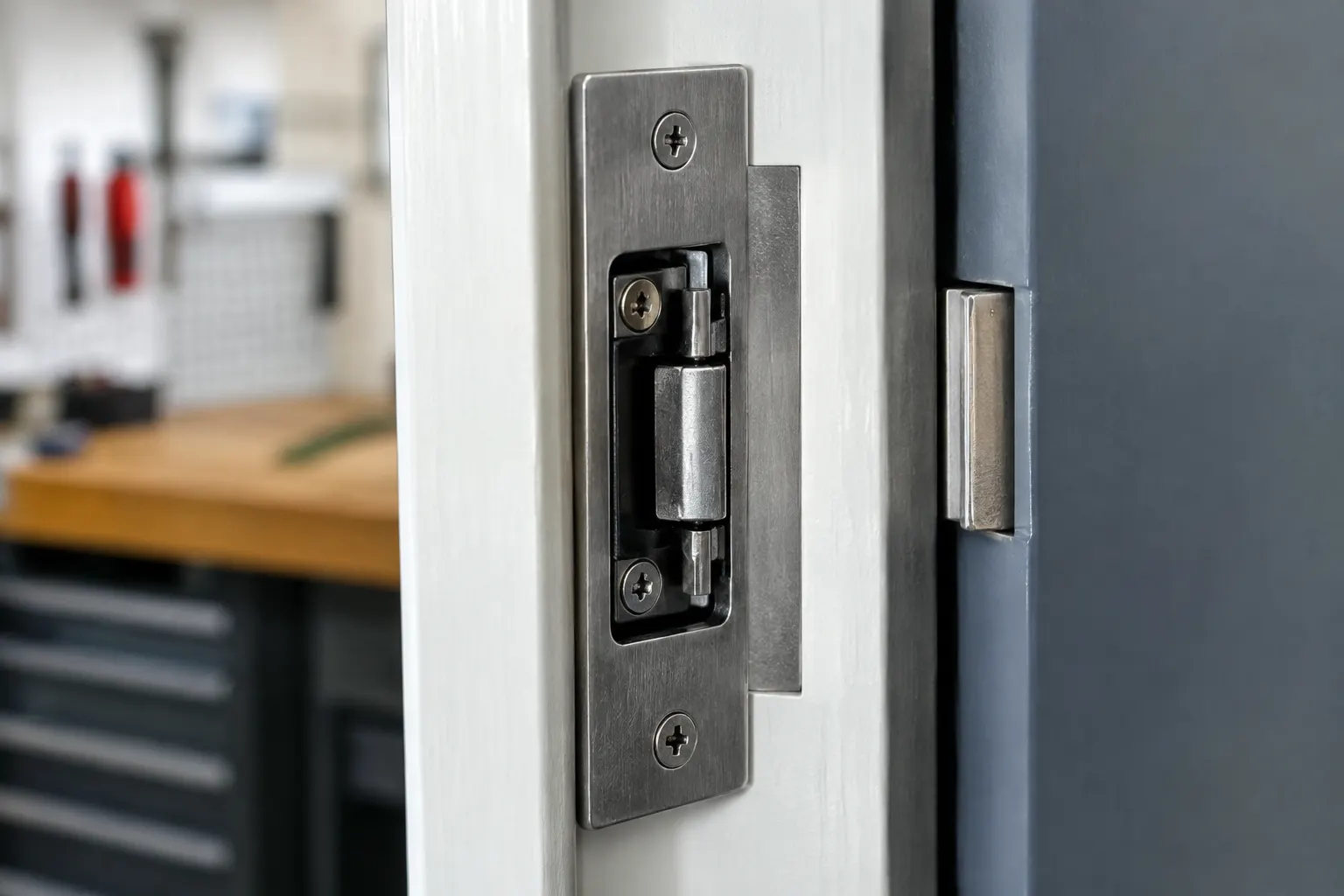
What is an electric door strike and how does it work?
Guides - 25 November 2026 · 6 min read

What is an electric door strike and how does it work?

An electric strike is a strike plate in the door frame with a moving part. When it receives a switching signal from the intercom, a button or a card reader, that part frees the latch of the lock and you can push the door open. The lock in the door itself stays mechanical. Most home doors use a fail-secure strike: without power the door stays shut.

What is an electric door strike and how does it work?
In this article
  • How exactly does an electric strike work?
  • What is the difference between fail-secure and fail-safe?
  • Which voltage do you need: 12 or 24 volts, AC or DC?
  • How do you keep the door unlocked during the day?
  • What does a feedback contact do?
  • May an electric strike be used on an escape door?
  • Electric strike or magnetic lock: which do you choose?
At a glance

In short

Fail-secure is locked without power, fail-safe is released without power.
A strike for 6 to 12 volts can ask for 1,150 mA at 12 volts AC, a 10 to 24 volt type from the same maker only 190 mA.
An electric strike only frees the latch, so with the deadbolt thrown the door stays shut.

How exactly does an electric strike work?

An ordinary strike plate is a hole in the frame that the slanted latch falls into. With an electric strike, one side of that hole is a flap that can tilt. At rest a small pawl holds the flap. When current flows through the coil, or disappears, the pawl comes free and the door pushes the flap aside.

From inside you still open the door with the handle. It pulls the latch back and does not need the strike. Outside there is therefore usually a fixed knob or pull: otherwise anyone with a normal handle could walk in.

The classic buzz is heard with alternating current. The flap then vibrates along with the voltage. With direct current you often hear only a click.

What is the difference between fail-secure and fail-safe?

Fail-secure means the strike is locked without power. You give a short pulse and the door can open. If the power fails, the door stays shut from outside and you use the key. This is standard for homes and apartment entrances.

Fail-safe is the opposite: as long as there is voltage it is locked, and without voltage it is released. That suits places where a door must be free in a fire or power failure. The price is that someone who switches off the supply is also inside.

In the datasheets we looked at, fail-safe strikes only work on direct current, with a coil for 12 or for 24 volts that may be energised continuously. So you cannot simply connect them to an old bell transformer.

Which voltage do you need: 12 or 24 volts, AC or DC?

Look at the strike first and then at the supply. Maasland makes a fail-secure type for 6 to 12 volts and one for 10 to 24 volts, both for alternating and direct current. The effeff 118 series from ASSA ABLOY comes for 10 to 24 and for 22 to 42 volts. Within such a range it works, but it does not behave the same everywhere.

Power draw differs enormously. On 12 volts AC the low type from Maasland is listed at 1,150 mA in the datasheet, the high one at 190 mA. An 8 VA transformer can deliver about 0.67 amps at 12 volts. That is too little for the first type: the door does not open or the bell fails along with it.

Time counts too. A standard Maasland strike may carry current on 24 volts for less than sixty seconds. With effeff the limit on that voltage is at most fifteen seconds, followed by forty-five seconds of rest. So set the relay to a few seconds and do not leave a fail-secure strike energised all day on a voltage it was not made for.

How do you keep the door unlocked during the day?

Many practices and shops want the door to open freely during the day. For that there are versions with a small lever in the strike, often called a release pawl or mechanical unlock. Once switched, the strike no longer holds the latch. Do put it back in the evening.

If you want it automatic, use a type that may be energised continuously, with a timer or access system. The effeff A71 version may for example receive power permanently up to 13 volts. On 24 volts it may not.

What does a feedback contact do?

A strike with a feedback contact has a tiny switch operated by the latch. The system can then see whether the latch lies in the strike. You get an alert if the door stays open too long or has not closed properly.

Mind what it does not measure. The contact says nothing about the deadbolt, nor whether the door is firmly locked. A real alarm signal needs a separate magnetic contact on the door.

May an electric strike be used on an escape door?

It can, if people can always leave at once from the inside. Article 6.21 of the Dutch Building Works Decree (Bbl) says a door on an escape route may only be shut if, while escaping, it opens immediately to the required width without a key. There are exceptions, among them an escape route that is not communal.

With a fail-secure strike and a normal handle on the inside that route stays free, because the handle works without power. So do not simply swap that handle for a fixed knob with an electric lock. For fire- and smoke-resisting doors there are also separate strikes, such as the 118F and 118S from effeff. A standard type does not belong there.

This is general information. For a business, care building or apartment block, look at the whole door with the fire safety adviser: hardware, closer, lock and power supply.

Electric strike or magnetic lock: which do you choose?

A magnetic lock is an electromagnet on the frame and a steel plate on the door. Without power it lets go, so it behaves like a fail-safe strike. One Maasland model holds 2,720 newtons according to the datasheet, about 272 kilos. A strike from the same maker reaches 3,230 newtons, but relies on the existing lock.

Choose a strike if there is a good lock with a latch in the door and you want to keep the key. Choose a magnet for a glass door or gate where no strike fits, and accept that it keeps drawing power. A magnet on an escape door always needs an emergency release and a well-considered power plan.

Frequently asked questions

Why does the door not open although I hear the strike?

Often the latch is under pressure from a draught seal or a warped door. A standard strike then does not let go: on 12 volts DC the effeff 118 may carry only 50 newtons of preload, on alternating current 200. Push the door to for a moment and try again.

Can I connect the strike to my existing bell transformer?

Only if voltage, type of current and power match. A fail-safe strike on an old AC transformer does not work, and a strike that draws a lot of current can overload the transformer.

Is an electric strike as burglar-resistant as a deadlock?

No. It only holds the latch. Turn the lock to the deadbolt at night or choose a self-locking lock that works with the intercom.

Can an electric strike be used outdoors in a gate?

Yes, with a version meant for it. For outdoor use effeff refers to another series than the ordinary 118. Also watch for water in the cable entry and play in the gate.

What is an electric keeper then?

It is the same part under another name. Door strike, electric release and strike plate are used interchangeably. So search by type number rather than by name.

Sources

What this information is based on

Maasland strike S00Voltage, current and holding force of fail-secure and fail-safe types.Datasheet Maasland S00 (pdf)
ASSA ABLOY effeff 118 seriesDuty cycle, preload, feedback and fire-resisting types.effeff 118 catalogue (pdf)
Bbl article 6.21Doors in escape routes while a building is in use.Text of article 6.21 (Dutch)
Maasland electromagnet 17DSMHolding force and behaviour without power.Electromagnet datasheet (pdf)
Get help

Let us take a look

Send us your situation or call us directly. We help with cameras, alarms, the app and installation.

Request a quote
AddedView →