
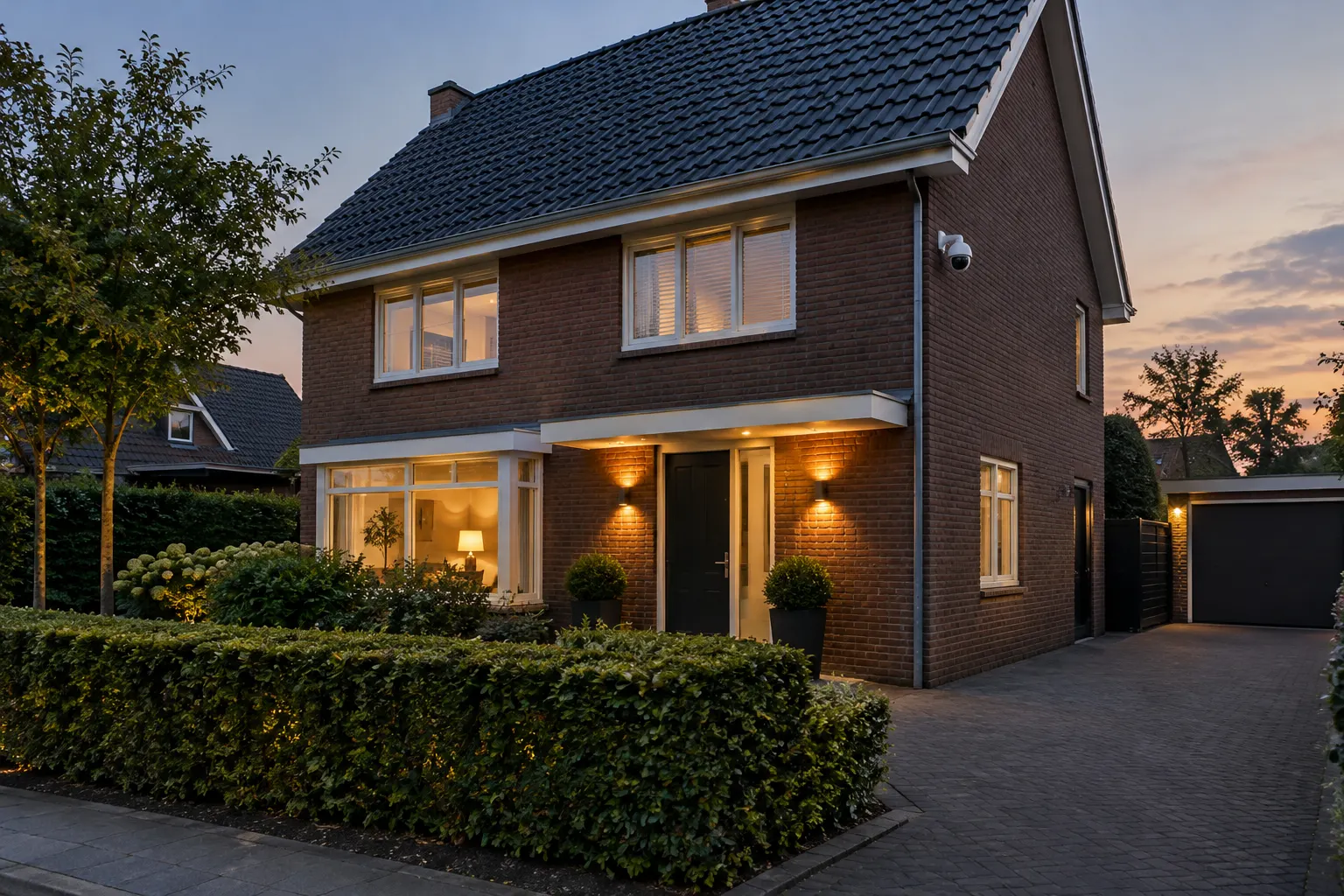
Securing your home against burglary: in which order do you do it?
Advice - 25 November 2026 · 6 min read

Securing your home against burglary: in which order do you do it?

Secure your home from the outside in: first close windows and lock doors, then fit approved hardware with SKG stars, then outdoor lighting and a clear view of doors and windows. An alarm and cameras come after that. They warn and record, but they do not keep a weak door shut.

Securing your home against burglary: in which order do you do it?
In this article
  • Step 1: what can you do today for free?
  • Step 2: which locks and door furniture do you need?
  • Step 3: how much light and visibility do you need outside?
  • Step 4: what use are neighbours and a lived-in look?
  • Step 5: when does an alarm system add something?
  • Step 6: what does a camera do and not do?
  • How do you turn this into a plan?
At a glance

In short

According to the Dutch Police Label Secure Housing (PKVW), a burglar is inside within half a minute to a minute on average; a home with the label keeps him out for at least three minutes.
In the winter-time period of 2025/2026 insurer Interpolis counted an average of 72 burglaries and attempts per day, against 55 in the summer-time period before it.
The Dutch government attributes 90 per cent of burglaries to opportunists: they take the house that opens most easily.

Step 1: what can you do today for free?

Lock every outside door, even if you only walk to the postbox round the corner. A door you merely pull shut hangs on the latch. With a piece of plastic between door and frame it opens in no time. Close windows that are ajar or tilted too, certainly above an extension or a wheelie bin.

Take keys out of the lock and keep them out of sight and out of reach of the letterbox. Do agree a fixed place with everyone at home, because in a fire you need them quickly. A key under the mat or an address tag on your key ring is asking for visitors.

Do not leave the ladder, the wheelie bin and the garden table under a window. This takes a quarter of an hour and you need nobody for it.

Step 2: which locks and door furniture do you need?

This is the step where your money does the most. Approved hardware carries the SKG logo with one, two or three stars. Against doors being forced, the PKVW advises at least two or three stars, with security furniture in a sturdy frame. Against cylinder pulling you choose a cylinder with anti-pull protection.

Measure how far your cylinder protrudes from the door furniture. More than three millimetres is too much: someone can then grip it with pliers and snap it. A ruler shows it and a new cylinder is quickly fitted.

Stars are not everything. A strong lock in a rotten frame still breaks out. Do not forget the sliding door, the balcony door and the roof window either. A PKVW company can check your home. If it complies, you receive a certificate for which some insurers give a discount on contents insurance.

Step 3: how much light and visibility do you need outside?

A burglar prefers to work where nobody sees him. Fit a lamp with a motion or dusk sensor at the back door and the gate. At the front, a lamp that glows softly all evening is more pleasant: you see who rings and your neighbours are not woken by a floodlight.

Then step into the street and look at your own house. Can you see the front door and the windows, or is there a hedge in front? Keep shrubs short and think twice about a solid two-metre fence next to a back door. Privacy for you is also privacy for whoever does not belong there.

Do not forget the gate and the shed. That is often where the very tools are kept that open your own back door.

Step 4: what use are neighbours and a lived-in look?

Act as if you are home. A lamp on, a cup on the table and no pile of leaflets on the mat. Vary the times of lamps. Lighting that comes on at the same minute every evening can actually reveal that nobody is there.

Exchange phone numbers with the neighbours beside and behind you. Agree who looks when something goes off at night. In a suspicious situation you may call 112, even if nobody is in danger. The police may then still be able to prevent something.

Write down serial numbers of valuables or put them in the Dutch Stop Heling app. It keeps nobody out, but it increases the chance of getting something back.

Step 5: when does an alarm system add something?

An alarm turns time into a problem for the burglar. The better you did step 2, the more it works: he is still prising at the door while the siren is already sounding. That is why contacts on doors and windows, possibly with vibration detection, are often more useful than just a motion detector in the living room. That only responds once someone is inside.

Decide beforehand who receives the notification and what that person does. A siren without anyone responding is noise. Also choose a system you will really arm. In a house with a cat and three teenagers that usually means a night mode that still lets you go to the toilet.

Step 6: what does a camera do and not do?

A camera is strong at seeing and proving. You get a notification at the gate, you can check whether it is the parcel courier and you have footage for a police report. Its preventive effect is more limited than many people think. The PKVW warns that a smart doorbell alone is not enough.

So choose one task per camera. One on the route to the back door, one at the front door, and only then the rest. Film your own property and as little pavement as possible. Do not mount it so high that you only see caps.

We sell cameras, and still we say it often: if there is an old cylinder in your back door, spend the first money there.

How do you turn this into a plan?

Spread it over three evenings. Evening one: everything in step 1 and a round of the house with a notepad. Evening two: count the stars on every lock and photograph what has to go. Evening three: look outside in the dark for where you could stand unnoticed yourself.

Put what you find in the order of this article. Then you do not start by buying what is most fun to unpack. Once everything up to and including the lighting is in order, you also know exactly which spots are left for a detector or a camera.

Frequently asked questions

What is a good security system for a house?

One that suits what is already in order. With good locks, a wireless alarm with contacts on the entrances is a logical basis. You add cameras in places where you want to know who is there.

Is the Police Label mandatory?

No, for an existing home it is your own choice. You can also just use the advice and the approved hardware. New-build homes have their own building rules, which are not the same as the label.

Does a sticker or dummy camera help against burglars?

Do not count on it. Someone who looks around often sees whether a camera is real and whether the door is closed. A sticker costs little, but does not replace a lock, light or notification.

What can I do in a flat?

Start with your own front door: cylinder, furniture and a door viewer or limiter. Then look at the communal entrance and storage rooms. Do not let strangers walk in with you and discuss lighting and locks in the owners’ association.

Do first-floor windows need to be locked too?

Yes, if someone can reach them. A wheelie bin, drainpipe, shed or extension makes a floor accessible. Secure balcony doors and roof windows as well and close them when you leave.

Sources

What this information is based on

PKVW: burglary methodsSKG stars, anti-pull protection and the three-millimetre limit (in Dutch).The most common burglary methods
PKVW: preventing burglaryHow much time a burglar needs and the role of cameras (in Dutch).Keeping burglars from striking
PKVW, 20 November 2026Interpolis figures on burglaries in winter time (in Dutch).More burglaries in winter time
Maak het ze niet te makkelijkGovernment campaign on opportunist burglary and prevention (in Dutch).Home burglary campaign
Get help

Let us take a look

Send us your situation or call us directly. We help with cameras, alarms, the app and installation.

Request a quote
AddedView →