Camera surveillance for farm and yard

Recreation, estate and association

Camera surveillance for farm and yard

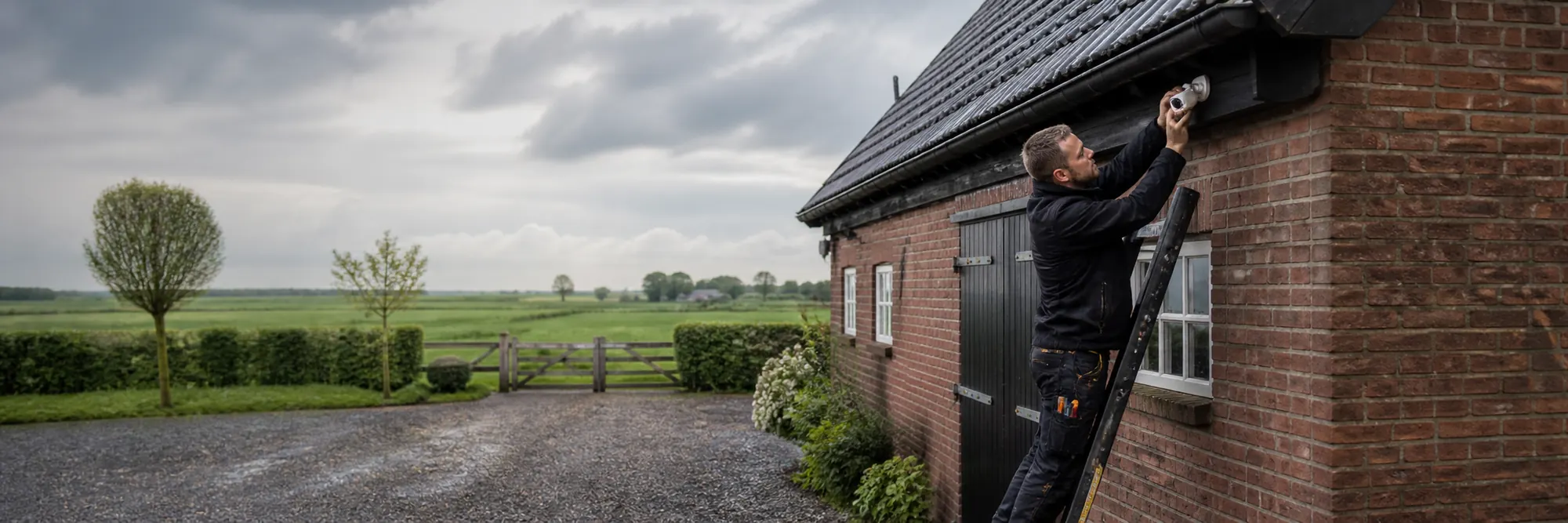
Camera surveillance for a farm: yard, barn, machine shed and diesel storage in view, with cables between buildings, dust and ammonia taken into account.

IP Camera Installatie: More than 2,000 businesses helped. View our projects · Read customer reviews

Fixed price in advance Installation on site Prefer to talk first? 085 - 02 12 771 WhatsApp
Camera surveillance for farm and yard
Home›Services›Camera surveillance for farm and yard

What is included

A view of a yard with several buildings and few eyes

On a farm the value stands outside. Tractors with GPS, a tank of diesel, tools in the shed and livestock in the barn. You are often out in the field or still milking when someone drives into the yard. Camera surveillance helps if the cables, the dust and the distances are right. That decides whether a system still works after a winter.

  • Approach road and yard with a place for a clear picture of vehicles
  • Machine shed and GPS receivers looked at separately from the barn
  • Cable route between buildings protected from rodents
  • Materials chosen for dust, damp and ammonia in the barn
  • Alerts that allow for livestock, contractors and early hours
01

The yard is not a street

A camera on the wall of the house sees the yard, but not the corner behind the silage clamp. So we walk round the farm and look at routes you do not normally use: the path along the ditch, the back of the shed and the neighbours’ drive. For vehicle images a spot at the entrance is useful, with light from the side and not against the setting sun. Dogs, cats and birds cause a lot of movement. It pays to agree per zone what is and is not worth an alert, or you will switch off the app after a week.

02

GPS, tools and diesel storage

GPS receivers and control screens are taken from tractors and then sold. The shed where they stand at night therefore deserves a plan of its own. A contact on the door gives a quick signal, a camera on the inside of the door shows who is walking around. Take loose screens out of the cab in the evening if you can and write down the serial numbers. The diesel tank is often a different risk: someone filling up by day is not always suspicious. Set a time schedule there and aim the camera at the filling place and the gate, not only at the tank itself.

03

Livestock, dust and ammonia

Barns are hard on technology. Ammonia attacks connectors and sometimes the housing too, dust puts a layer on the lens and a high-pressure cleaner does the rest. Look at the protection class: a camera that may go under water is not automatically able to withstand a hard jet from close by. So mount it above the reach of the sprayer and make the connection in a sealed box. In the calving barn a camera is an aid for not having to get up every time at night. It does not replace the round, nor your own eye for an animal that behaves differently.

04

Cables between buildings

A farm consists of several buildings, often each with its own meter cupboard. Lightning and differences in voltage are a real concern there. For the distance between barn and house, fibre optic is often safer than copper because it carries no voltage. If there is already a duct, we check that it is clear. Rats and martens like to gnaw, so cables go through a strong sheath and not loose over the trusses. A wireless link between buildings is possible too, with a clear line of sight and a fixed direction. Vegetation and a tall vehicle parked in the way easily block that, so we test after installation.

05

Slurry storage and other dangerous places

Gases that are poisonous or explosive can be released around slurry pits and mixers. We do not hang an ordinary camera or cable there. A view of the outside, the cover and the access is often enough to see whether someone left the covering open. We keep the equipment itself away from the pit. In case of doubt ask your supplier or adviser about safety on your farm. A camera is no gas meter. For such spaces the procedure of ventilating, measuring and not working alone always applies.

06

Early shifts and changing hands

Milkers, contractors, a student in the summer, the vet and the fertiliser delivery: many people who do not come every day walk around a farmyard. To keep alerts useful we make separate time slots for milking, harvest and night. You choose who may look along. A family member in another house can receive an alert without being able to reach the settings. Put a sign at the entrance and tell staff that there are cameras, even when the yard is also your home. Turn the lens away from the neighbours’ back garden and the public road.

Regional coverage

Farm camera surveillance in your area

We also travel throughout the Netherlands for camera surveillance for a farm. Choose a city to see how we plan an installation there.

View service area →

Clear answers

Frequently asked questions

Can a camera warn me at calving?

You can watch live and with some models get an alert on movement. It does not automatically recognise a birth and does not replace the round through the barn.

Which camera lasts in a barn?

Choose for dust, damp, ammonia and high-pressure cleaning. For each place we look at what the manufacturer allows and hang it so it can still be reached for cleaning.

Do I need a separate internet connection for every shed?

No. You usually link the buildings by cable, fibre or a wireless connection and everything runs through one router. We make that plan from the distances and existing ducts.

Do I get an alert for every cow that walks past?

That happens if the zone is not well chosen. We set person detection and time slots, but with livestock in view it remains tricky.

Can I place a camera in a remote field?

With mobile internet and a suitable power supply it sometimes can. The solar panel and battery then have to deliver enough, even in November. We work that out before we propose anything.

AddedView →