
May a doorbell camera film the pavement or street in the Netherlands?
Doorbells - 25 November 2026 · 5 min read

May a doorbell camera film the pavement or street in the Netherlands?

In the Netherlands a doorbell camera may in principle film only your own property, so not the pavement or street. There is an exception: if your front door opens directly onto the public road and there is really no alternative, a small strip may be in view. You must be able to explain it, spare passers-by as much as possible and keep footage briefly.

May a doorbell camera film the pavement or street in the Netherlands?
In this article
  • When may a strip of pavement be in view?
  • Does household use not cover you?
  • How do you set up a doorbell with privacy in mind?
  • May you record sound and recognise faces?
  • How long may you keep and share doorbell footage?
  • What can happen if you film too much?
At a glance

In short

As soon as a doorbell records even part of the street, the GDPR applies to you as a resident.
The Dutch data protection authority (AP) gives 24 hours as an example of a short retention period at home.
The AP received over 550 complaints about neighbours’ cameras and doorbells in 2025. Up to March 2026 no fine had ever been issued.

When may a strip of pavement be in view?

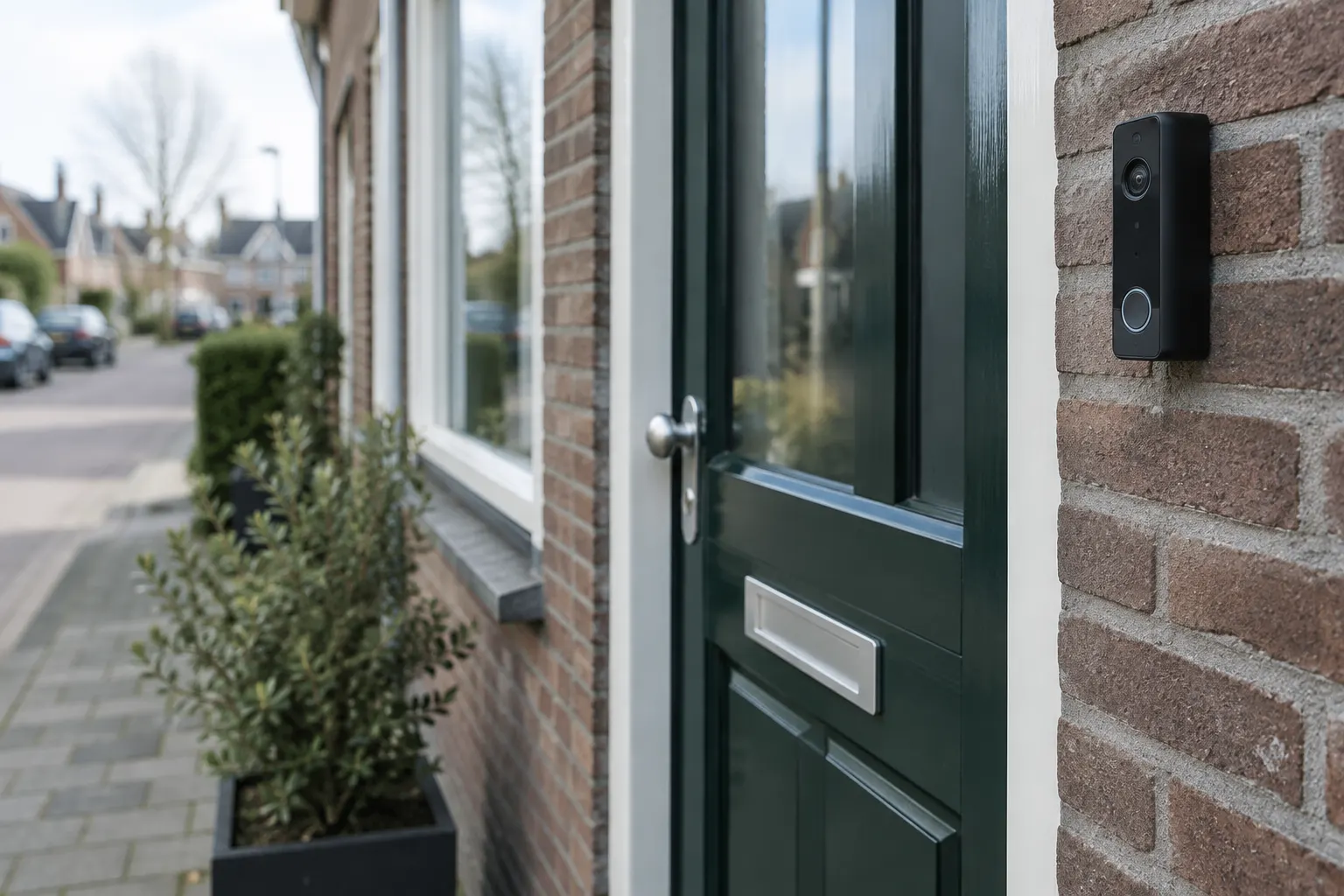
It depends on your front door. If you have a front garden of five metres, you can aim the doorbell so that the picture stops at the hedge. There is then no good reason to show the pavement. If you live in a terraced house with the door right on the pavement, every visitor stands on public ground. A strip of pavement is then unavoidable.

The Dutch data protection authority gives a useful example itself. If your scooter is parked in the street and you want to guard it, you may film the bit of street where the scooter stands, not the whole street. Apply that to your doorbell: show who rings, not who leaves the house across the road.

Deliberately filming the whole street is allowed only in very exceptional cases, for instance with many burglaries in the area and when nothing else helps. A vague feeling of being unsafe is not enough. You must be able to demonstrate the problems.

Does household use not cover you?

The GDPR does not apply to purely personal or household activities. Many people rely on that, but for cameras the exception is narrow. Back in 2014 the European Court of Justice ruled in the Ryneš case that a camera covering even part of a public space does not fall under it.

The European supervisory authorities give an example that does fit: someone films his own fenced garden, used mainly by himself and his family. A doorbell facing the street is nearly always something else. So assume that you have rules to follow: informing, securing, keeping footage briefly and responding if someone wants to see footage of themselves.

How do you set up a doorbell with privacy in mind?

Start with the position. A doorbell has a wide lens, often vertically as well. An angled mounting plate that turns it towards your own path removes more street than any setting. After fitting, check on your phone what is really in view, by day and in the dark.

Then look in the app for privacy zones or masking. Such a zone blacks out part of the picture, in the recording too. Do not confuse this with a motion zone. That only decides when you get an alert, while the rest is still filmed. The two are easily confused, so always check a recorded clip.

If the doorbell can automatically blur the faces of passers-by, switch that on when the pavement is in view. Let it record only when someone rings, rather than at every movement. That also saves dozens of pointless alerts a day.

May you record sound and recognise faces?

Talking through the doorbell to someone who rings is not a problem. Recording sound continuously is another matter. The microphone picks up conversations of people walking past who have nothing to do with you. Secretly recording a conversation you are not part of can even be a criminal offence. So switch off audio recording if the app allows it.

Facial recognition makes the intrusion greater still, the supervisory authority warned in September 2025. In effect it creates a list of who passes and when. For a front door you do not need that.

How long may you keep and share doorbell footage?

As briefly as possible. The AP gives 24 hours as an example. An advisory report for municipalities, published in early 2026 by their association VNG, speaks of deleting after two weeks. Storing nothing at all is of course fine too. You then only watch live when someone is at the door.

Sharing in the neighbourhood chat or online is allowed only with the consent of anyone recognisable. That includes the parcel thief. Give such a clip to the police when you report the crime. With cloud storage, check where the servers are. Local storage on a card or base station is better for privacy according to the authority.

What can happen if you film too much?

It usually starts with a neighbour mentioning it. Show your picture and adjust it. In practice that settles things faster than an exchange of letters. If it does not work out, the other person can turn to neighbourhood mediation or the community police officer, complain to the AP or go to court.

In 2024 the AP received 370 complaints about private cameras; in 2025 over 550 about neighbours’ cameras and doorbells. According to NOS no fines had ever been issued for them up to March 2026. That does not mean anything goes. A court can order you to move or remove the camera.

Municipalities have little room to make doorbell rules of their own, the report for VNG showed. The national privacy rules therefore remain leading. This explanation covers the Netherlands, is general and does not replace a lawyer’s advice in an ongoing dispute.

Frequently asked questions

Do I need a sticker next to my doorbell camera?

People who ring your bell must know that they are being filmed. A sticker by the bell or on the gate is a simple way to do that, so that someone can also choose not to ring.

May a doorbell camera film the front door opposite?

No. Other people’s homes and doors should not be in view. Turn the doorbell, choose an angled mounting plate or place a privacy zone over them.

Do the rules apply if the doorbell only shows a live view?

Live viewing without storage is far less intrusive and is mentioned by the authority as a good alternative. The direction of the camera still matters: live or not, someone else’s garden or door should not be on it.

May I fit a doorbell camera in a shared porch or gallery?

Neighbours walk past your door there and the space often belongs to an owners’ association or landlord. Ask permission first and choose a doorbell that opens only when someone rings and shows as little of the walkway as possible.

Can my neighbour request his footage?

Anyone you have filmed has privacy rights, including the right to see footage of themselves. If you have kept nothing, that is a clear answer as well.

Sources

What this information is based on

Cameras at your own homeRules from the authority, for doorbell cameras too (Dutch).Dutch data protection authority
AP on doorbell camerasComplaint figures and warning of 23 September 2025 (Dutch).AP, news item
Municipalities and smart doorbellsAdvisory report, 5 February 2026 (Dutch).VNG
Guidelines 3/2019 on video devicesHousehold exception and the Ryneš judgment, section 2.3.EDPB
Get help

Let us take a look

Send us your situation or call us directly. We help with cameras, alarms, the app and installation.

Request a quote
AddedView →